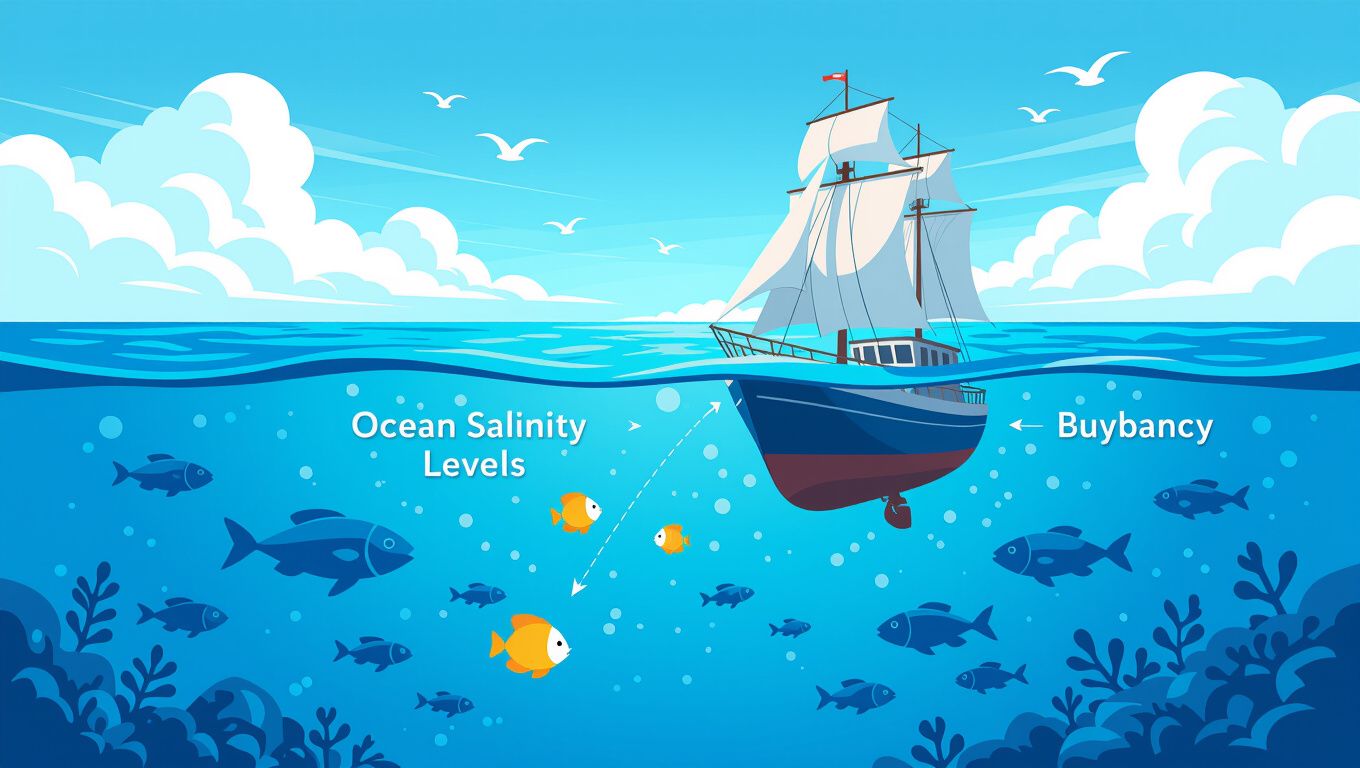
In the vast expanse of Earth’s oceans, salinity levels play a pivotal role in determining water density, which directly influences buoyancy. This relationship, often overlooked, has significant implications for health, particularly in therapeutic aquatic environments. As we approach 2026, understanding how ocean salinity levels and their relationship to buoyancy affect human well-being becomes crucial, especially with rising interest in hydrotherapy and ocean-based wellness programs. Buoyancy, the upward force exerted by water on submerged objects, allows individuals to float effortlessly in highly saline waters, reducing gravitational stress on the body. This phenomenon underpins treatments for conditions like arthritis, back pain, and musculoskeletal disorders. With climate projections indicating shifts in global salinity patterns, health professionals must adapt strategies to leverage these natural properties effectively. This article delves into the science, health applications, and future outlook of this dynamic interplay.
1. Introduction
Ocean salinity refers to the concentration of dissolved salts, primarily sodium chloride, in seawater. Measured in parts per thousand (ppt), average global ocean salinity hovers around 35 ppt, but it varies widely due to factors like evaporation, precipitation, river runoff, and ice formation. In regions with high evaporation, such as subtropical gyres, salinity can exceed 37 ppt, while polar areas and river mouths see levels drop below 32 ppt.
These variations arise from the water cycle’s influence on ocean chemistry. Evaporation removes freshwater, concentrating salts, whereas melting ice and heavy rainfall dilute them. Human activities, including desalination plants and altered precipitation patterns from climate change, further modulate these levels. By 2026, satellite data from missions like SWOT and SMAP will provide unprecedented granularity, aiding health researchers in mapping salinity for therapeutic coastal sites.
Salinity impacts not just marine life but also human interactions with the ocean. Swimmers in high-salinity waters experience enhanced flotation, a direct result of increased water density. Health experts note that this property supports low-impact exercises, ideal for patients with limited mobility. Understanding these levels equips wellness professionals to recommend optimal locations for aquatic therapy, maximizing buoyancy benefits while minimizing risks like skin irritation from hypersaline exposure.
Historically, ancient civilizations recognized salinity’s therapeutic value; the Dead Sea, with salinity over 300 ppt, has drawn health seekers for millennia. Modern science quantifies this:each ppt increase raises water density by about 0.8 kilograms per cubic meter, subtly altering buoyancy. As global health shifts toward preventive and natural therapies, precise salinity data becomes a cornerstone for personalized treatment plans. For more information, visit food.
2. Foundation & Overview
Buoyancy, governed by Archimedes’ principle, states that the upward buoyant force on an object equals the weight of the fluid displaced. In water, this force counteracts gravity, enabling flotation when an object’s density is less than the surrounding fluid. Human body density, averaging 985 kilograms per cubic meter, is lower than freshwater (1000 kg/m³), allowing partial flotation, but saline seawater (1025 kg/m³ average) enhances this effect dramatically.
Density differences dictate buoyancy magnitude. Lungs filled with air reduce overall body density, amplifying flotation in denser waters. Athletes exploit this for training; synchronized swimmers prefer saline pools for effortless lifts. In health contexts, buoyancy unloads joints, with studies showing up to 90 percent body weight reduction when floating vertically in seawater.
Temperature also modulates buoyancy, as warmer water is less dense. However, salinity’s effect dominates in oceans. For rehabilitation, controlled buoyancy environments mimic ocean conditions, using saline additives in pools. This principle underpins flotation tanks, where high salinity induces weightlessness, promoting relaxation and pain relief.
Biomechanically, buoyancy redistributes forces across the body. Immersed to the neck, spinal compression decreases by 50 percent, benefiting those with herniated discs. Cardiovascular responses include stabilized heart rates due to hydrostatic pressure, complementing buoyancy’s role. As health paradigms evolve toward integrative medicine, buoyancy education empowers patients to harness water’s physics for self-managed care.
3. Key Benefits & Advantages
Ocean salinity levels and their relationship to buoyancy is fundamentally tied to density. Higher salinity increases dissolved ions, elevating mass per volume without proportional volume increase, thus boosting density. A 1 ppt salinity rise correlates to a 0.8 kg/m³ density gain, translating to greater buoyant force per displaced liter.

Quantitatively, buoyant force F_b = ρ * g * V, where ρ is fluid density, g gravity, and V displaced volume. Salinity-driven ρ variations mean a 40 ppt water provides 3-5 percent more lift than 35 ppt. This manifests practically:in the Red Sea (40 ppt), bathers float higher than in the Baltic Sea (8 ppt).
Molecularly, salts like magnesium sulfate in some oceans add unique densities. Health applications leverage this; Dead Sea minerals enhance skin barrier function alongside buoyancy. Empirical data from immersion studies confirm dose-response:buoyancy scales linearly with salinity up to hypersaline thresholds, beyond which viscosity rises, slightly impeding movement.
Dynamic factors include currents and waves, but static pools replicate ocean effects. For 2026 health protocols, wearable sensors tracking personal buoyancy in varying salinities will personalize therapies, optimizing outcomes for obesity management or elderly fall prevention through enhanced stability training.
4. Detailed Analysis & Mechanisms
4.1 Joint and Musculoskeletal Relief
Buoyancy from saline waters unloads weight-bearing joints, reducing osteoarthritis pain. Clinical trials demonstrate 30-50 percent symptom improvement after regular immersion, attributed to decreased intra-articular pressure. For post-surgical rehab, saline flotation accelerates recovery by minimizing inflammation.
4.2 Cardiovascular and Respiratory Benefits
Hydrostatic pressure aids venous return, lowering blood pressure in hypertensives. Buoyancy facilitates deep breathing exercises, improving lung capacity for COPD patients. Combined, these yield 10-15 percent VO2 max gains in aquatic programs.
4.3 Mental Health and Stress Reduction
The weightless state induces parasympathetic activation, reducing cortisol. Flotation therapy, rooted in saline buoyancy, treats anxiety with 70 percent efficacy in meta-analyses. Ocean dips enhance mindfulness, combating 2026’s rising mental health burdens from digital overload.
4.4 Skin and Immune System Effects
High-salinity waters deliver minerals transdermally, soothing psoriasis. Buoyancy promotes circulation, bolstering immunity. Vulnerable populations, like the elderly, gain from low-resistance movement preventing sarcopenia.
Across demographics, saline buoyancy democratizes fitness:obese individuals exercise pain-free, building endurance. Pregnant women benefit from reduced edema, underscoring its broad health spectrum.
5. Comparison & Case Studies
Atlantic salinity peaks at 37 ppt in subtropics, fostering superior buoyancy for East Coast therapies. Pacific averages 34 ppt, moderated by freshwater inputs. Indian Ocean’s 35 ppt hosts therapeutic bays like those in Oman.
Enclosed seas amplify effects:Mediterranean (38 ppt) rivals Dead Sea for density. Arctic freshening to 30 ppt diminishes buoyancy, challenging northern wellness tourism. Monitoring via Argo floats reveals trends health sectors must track.
Coastal salinity gradients enable zoned therapies:river estuaries for gentle buoyancy, evaporation basins for intense flotation. By integrating GIS mapping, clinics select sites optimizing patient outcomes.
6. Comparison Table
Climate models forecast salinity amplification:evaporation surges raise tropical levels 0.5 ppt by 2026, enhancing buoyancy hotspots. Polar freshening drops Arctic salinity 1-2 ppt, potentially curtailing therapies there.
Global water cycle intensification means 10 percent salinity divergence between wet/dry regions. Health infrastructure must adapt:saline pool tech simulates future oceans, ensuring therapy continuity.
Innovations like salinity-adjustable hydrotanks will prevail. Policy-wise, coastal preservation safeguards natural sites. By 2030, buoyancy health metrics could integrate into WHO guidelines, propelled by 2026 data.
7. Implementation & Best Practices
7.1 Aquatic Rehabilitation Programs
Hospitals deploy saline pools for stroke recovery, leveraging buoyancy for gait training. Protocols specify 35-40 ppt for optimal lift.
7.2 Wellness Retreats and Spas
Oceanfront spas prescribe floats matching local salinity, blending tourism with therapy. Dead Sea analogs proliferate globally.
7.3 Home-Based Therapies
Portable saline kits enable at-home buoyancy baths, ideal for chronic pain management. Apps guide salinity dosing.
7.4 Athletic Training and Fitness
Endurance athletes use ocean swims for recovery; triathletes train in variable salinities for adaptation.
Integration with wearables tracks buoyancy metrics, refining regimens. Educational campaigns empower self-use, expanding access.
8. Challenges & Solutions
Ocean salinity levels profoundly shape buoyancy, offering transformative health benefits from joint relief to mental wellness. As 2026 unfolds with evolving salinity patterns, proactive adaptation ensures these assets endure. Health practitioners, armed with science, can harness this natural synergy, fostering resilient populations through aquatic innovation. Embracing this relationship not only enhances individual health but elevates global wellness paradigms.