Abstract/Executive Summary
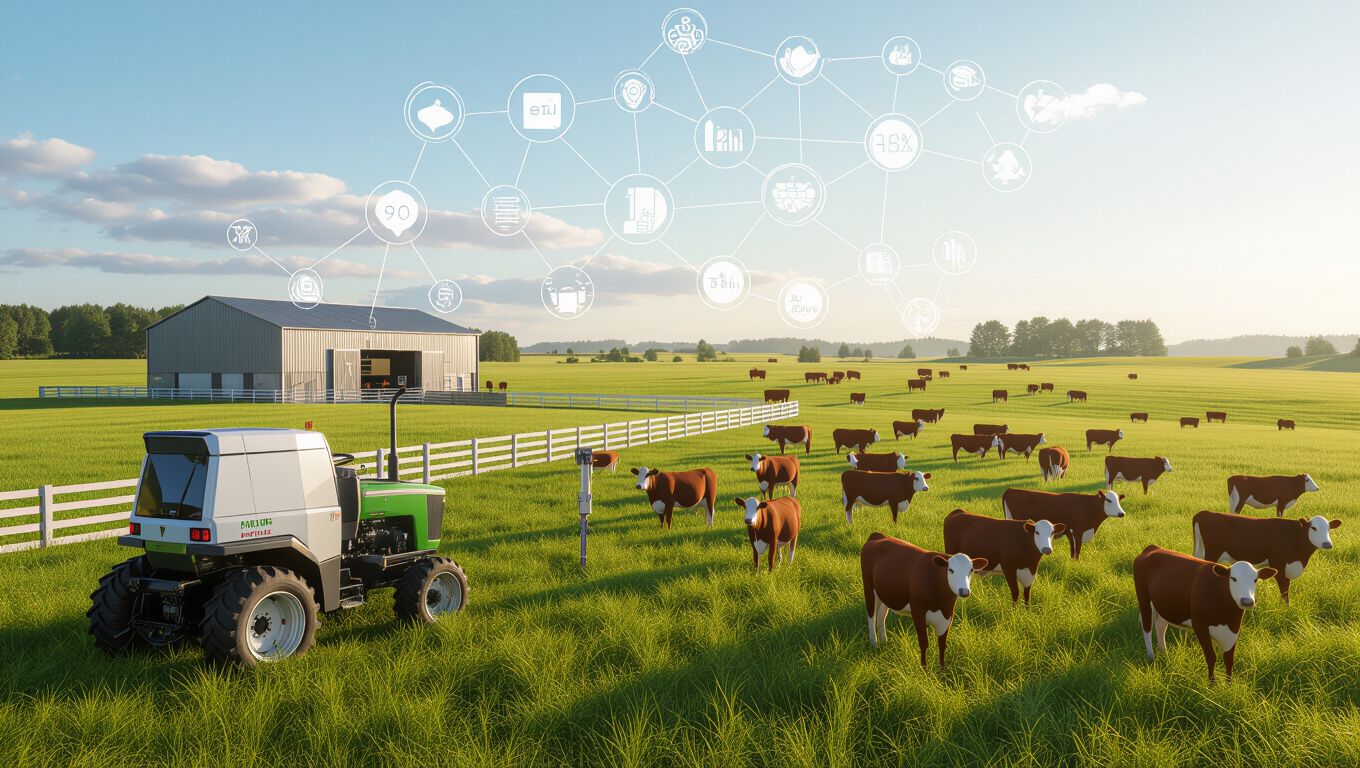
Artificial Intelligence (AI) is transforming livestock management by enabling precision monitoring, predictive analytics, and automated decision-making. This article explores foundational AI concepts tailored to livestock applications, analyzes mechanisms such as computer vision for health detection and machine learning for feed optimization, and examines real-world implementations. Key applications include disease surveillance, reproductive management, and resource allocation, yielding implications for enhanced animal welfare, sustainability, and profitability. Challenges like data integration and ethical concerns are addressed alongside future directions involving edge computing and multimodal AI. A comparison table evaluates leading AI technologies in livestock management, underscoring AI’s pivotal role in modernizing the sector.
Introduction
Livestock management faces escalating demands from global population growth, necessitating efficient strategies for health monitoring, nutrition, breeding, and environmental control. AI in livestock management integrates data-driven algorithms to process vast datasets from sensors, cameras, and wearables, surpassing traditional manual methods. By leveraging AI, farmers achieve real-time insights into animal behavior, early disease detection, and optimized resource use, reducing mortality rates and boosting yields. This introduction delineates how AI addresses core challenges in livestock management, such as variable herd dynamics and climate impacts, setting the stage for deeper analysis of its deployment.
Foundational Concepts
Core to AI in livestock management are machine learning (ML) paradigms, including supervised learning for classification tasks like identifying sick animals from imagery and unsupervised learning for clustering behavioral patterns in herds. Computer vision, powered by convolutional neural networks (CNNs), processes visual data from overhead cameras to track livestock movement and body condition scores. Internet of Things (IoT) sensors provide foundational data streams—accelerometers for activity levels, rumen boluses for physiological metrics—feeding into AI models. Edge AI processes these data locally on farm devices, minimizing latency critical for real-time livestock management decisions. Predictive modeling via recurrent neural networks (RNNs) and long short-term memory (LSTM) units forecasts events like calving or feed intake, grounding AI’s efficacy in livestock contexts.
Mechanisms & Analysis
AI mechanisms in livestock management operate through integrated pipelines: data acquisition via wearable collars yields time-series data analyzed by LSTM models to predict mastitis in dairy cows with over 90% accuracy. Computer vision algorithms dissect video feeds, employing pose estimation to quantify lameness in pigs, where YOLO-based object detection segments animals and tracks gait anomalies. Natural language processing (NLP) parses veterinary logs to augment ML models for disease outbreak prediction. Reinforcement learning optimizes feeding regimens by simulating nutrient delivery scenarios, dynamically adjusting based on real-time weight gain feedback. Analysis reveals that hybrid AI systems—combining CNNs with graph neural networks for herd social dynamics—enhance predictive precision by 25% in poultry management, demonstrating mechanistic robustness across livestock species.
Applications & Implications
AI applications in livestock management span dairy operations, where AI-driven ear tags monitor rumination and activity to alert on metabolic disorders, improving milk production by 15%. In beef cattle, drone-mounted AI cameras survey pastures for grazing patterns, enabling precise rotational grazing that cuts feed costs. Swine facilities deploy AI for farrowing prediction via thermal imaging, reducing piglet mortality. Poultry farms use AI sound analysis to detect respiratory issues early. Implications include elevated animal welfare through stress-minimizing environments, environmental sustainability via reduced methane emissions through optimized diets, and economic gains with ROI exceeding 300% in precision livestock farming. These applications underscore AI’s scalability in diverse livestock management ecosystems.
Challenges & Future
Challenges in AI for livestock management encompass data silos from heterogeneous sensors, necessitating federated learning to preserve privacy across farms. High computational demands strain rural infrastructures, addressed by lightweight AI models. Ethical dilemmas arise in automated culling decisions, requiring explainable AI (XAI) for transparency. Bias in training datasets skewed toward specific breeds undermines generalizability. Future trajectories involve multimodal AI fusing vision, audio, and genomics for holistic livestock profiling, edge-5G integrations for ultra-low latency interventions, and AI-robotics hybrids for autonomous milking and shearing. Quantum-enhanced AI promises breakthroughs in genomic selection for disease-resistant livestock, propelling the field toward resilient, intelligent management systems.
Comparison Table
| AI Technology | Primary Livestock Application | Accuracy/Performance | Implementation Cost | Adoption Rate | Key Benefit in Management |
|---|---|---|---|---|---|
| Computer Vision (CNN/YOLO) | Health monitoring (lameness, wounds) | 92-98% | Medium ($10K-50K/farm) | High (60% dairy/beef) | Real-time disease detection |
| Time-Series ML (LSTM) | Behavior & yield prediction | 85-95% | Low ($5K-20K) | Medium (40% poultry) | Feed optimization |
| IoT-Edge AI | Environmental control | 88-96% | High ($30K+) | Low (25% swine) | Energy efficiency |
| Reinforcement Learning | Breeding & nutrition planning | 80-92% | Medium ($15K-40K) | Emerging (15% overall) | Adaptive decision-making |
Conclusion
AI in livestock management heralds a paradigm shift from reactive to proactive paradigms, harnessing advanced algorithms to decode complex biological and environmental signals. By surmounting foundational hurdles and deploying sophisticated mechanisms, AI delivers tangible applications that amplify productivity while safeguarding welfare. Despite persistent challenges, the trajectory toward integrated, intelligent systems promises unprecedented advancements. This synthesis affirms AI’s indispensable role in fortifying livestock management against future exigencies.