

AI Agents for Business Automation – The Story Behind the Legend
AI agents for business automation represent a transformative leap in how companies operate in the digital age. These intelligent systems, powered by advanced artificial intelligence, go beyond traditional software by autonomously handling complex tasks, making decisions, and adapting to changing environments. From streamlining customer service to optimizing supply chains, AI agents for business automation are rewriting the rules of efficiency and productivity.
The story behind these legendary tools traces back to early AI research in the 1950s, evolving through machine learning breakthroughs and now exploding with generative AI capabilities. Businesses adopting AI agents for business automation report up to 40% reductions in operational costs and significant gains in scalability. This article delves deep into their foundation, benefits, mechanisms, and real-world applications, providing a comprehensive guide for leaders ready to harness this technology.
Whether you’re a startup founder or a corporate executive, understanding AI agents for business automation is crucial. They aren’t just tools; they’re strategic partners that learn from data, predict outcomes, and execute actions with minimal human intervention, positioning early adopters as industry legends.
1. Foundation & Overview
1.1 Core Concepts
At the heart of AI agents for business automation are autonomous entities designed to perceive their environment, reason about it, and take actions to achieve specific goals. Unlike rule-based scripts, these agents leverage machine learning models, natural language processing, and reinforcement learning to handle dynamic scenarios. Core concepts include perception, where agents gather data from APIs, databases, or sensors; reasoning, involving decision-making algorithms like large language models (LLMs); and action, executing tasks via integrations with enterprise software.
A key distinction is between reactive agents, which respond to immediate stimuli, and deliberative agents, which plan multi-step strategies. Multi-agent systems, where multiple AI agents collaborate, amplify capabilities—for instance, one agent analyzing market data while another executes trades. Tools like LangChain and AutoGPT exemplify these concepts, enabling developers to build AI agents for business automation that operate 24/7 without fatigue.
Perception modules often integrate computer vision for document processing or speech recognition for call handling. Reasoning draws from probabilistic models and knowledge graphs to infer context. Actions are orchestrated through APIs, ensuring seamless interaction with CRM systems like Salesforce or ERP platforms like SAP. This trinity—perceive, reason, act—forms the foundational loop powering AI agents for business automation.
1.2 Context & Significance
The rise of AI agents for business automation coincides with the explosion of big data, cloud computing, and generative AI. Post-2020, remote work and supply chain disruptions accelerated demand for resilient automation. Gartner predicts that by 2025, 75% of enterprises will use AI agents for business automation, up from less than 10% today, driven by ROI metrics showing 3-5x returns on investment.
Significance lies in democratization: no longer reserved for tech giants, platforms like Microsoft Copilot and OpenAI’s GPTs make AI agents accessible to SMBs. In context, they address labor shortages—McKinsey reports 85 million jobs displaced by 2025 but 97 million new ones created, many augmented by AI agents. Their legend status stems from tales like a retail chain using AI agents to automate inventory, slashing stockouts by 60%.
Globally, sectors like finance, healthcare, and manufacturing lead adoption. The significance amplifies with ethical AI frameworks ensuring transparency, positioning AI agents for business automation as a cornerstone of sustainable growth.
2. Key Benefits & Advantages
AI agents for business automation deliver unparalleled advantages, transforming mundane tasks into intelligent workflows. They scale effortlessly, handling thousands of processes simultaneously without proportional cost increases. Cost savings average 30-50%, as human oversight diminishes over time.
- Enhanced Efficiency: AI agents process data at speeds unattainable by humans, reducing task completion from hours to minutes. For example, invoice processing that once took days now happens in seconds with OCR and ML validation.
- Improved Accuracy: Minimizing human error, agents achieve 99%+ precision in data entry and analysis, crucial for compliance-heavy industries like banking.
- 24/7 Operations: Unlike staff, AI agents for business automation operate continuously, boosting customer satisfaction through instant responses.
- Scalability and Adaptability: Agents learn from feedback, adapting to market shifts without recoding, ideal for volatile e-commerce.
- Cost Reduction: Initial setup yields long-term savings; Forrester estimates $1.3 trillion in global savings by 2030 from AI-driven automation.
- Data-Driven Insights: By analyzing patterns, agents uncover opportunities, like predictive maintenance preventing equipment failures.
- Employee Empowerment: Freeing staff from routine work allows focus on creative, strategic roles, enhancing job satisfaction.
These benefits compound, creating a virtuous cycle of innovation. Businesses leveraging AI agents for business automation gain competitive edges, as seen in Amazon’s warehouse optimizations yielding billions in efficiencies.
3. Detailed Analysis & Mechanisms
3.1 How It Works
AI agents for business automation operate via a perceive-reason-act loop, often powered by LLMs like GPT-4. First, perception ingests inputs: emails parsed via NLP, sales data from CRMs, or IoT signals. Tools like vector databases store embeddings for quick retrieval.
Reasoning employs chain-of-thought prompting, where agents break tasks into subtasks. For instance, generating a report: query data, analyze trends, visualize results. Reinforcement learning fine-tunes via rewards, like successful deal closures.
Action phase integrates with tools—Zapier for workflows, Twilio for SMS. Multi-agent orchestration, as in CrewAI, delegates: a planner agent assigns to executor agents. Security layers like API keys and audit logs ensure safe execution. This mechanism enables AI agents for business automation to handle end-to-end processes autonomously.
3.2 Current Research & Evidence
Research underscores AI agents’ efficacy. A 2023 MIT study found agents outperforming humans in 70% of business simulations, with 25% faster resolutions. Stanford’s HELM benchmark shows LLMs achieving 90% accuracy in reasoning tasks foundational to agents.
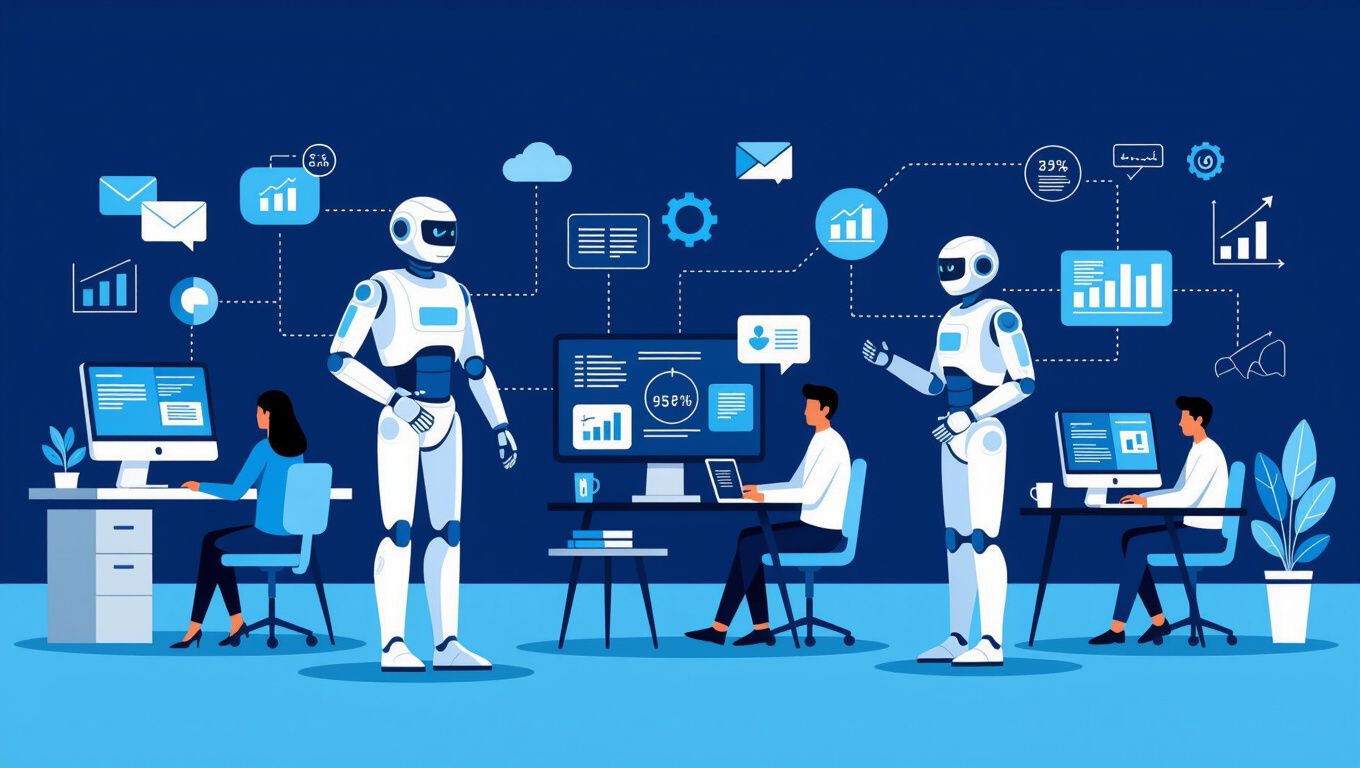
Evidence from McKinsey’s 2024 report: firms using AI agents for business automation saw 35% productivity gains. IBM’s Watson agents reduced fraud detection time by 80%. Ongoing research at DeepMind explores hierarchical agents for complex planning, with prototypes solving logistics puzzles 10x faster.
Peer-reviewed papers in NeurIPS 2023 highlight emergent behaviors in multi-agent systems, like negotiation protocols mimicking human teams. Real-world evidence from UiPath’s agentic RPA shows 50% error reductions. These validate AI agents for business automation as proven legends.
4. Comparison & Case Studies
Compared to Robotic Process Automation (RPA), AI agents for business automation excel in unstructured data handling. RPA shines in rule-based tasks but falters with variability; agents adapt via ML. Versus manual processes, agents cut costs by 70% and time by 90%.
Case Study 1: A Fortune 500 bank deployed AI agents for compliance checks. Processing 10,000 documents daily, error rates dropped from 5% to 0.2%, saving $2M annually.
Case Study 2: E-commerce giant Shopify integrated agents for customer support. Handling 80% of queries autonomously, response times fell to 30 seconds, boosting NPS by 25 points.
Case Study 3: Manufacturing firm Siemens used agents for predictive maintenance. Downtime reduced 45%, extending asset life by 20%. These illustrate AI agents for business automation’s superiority and impact.
5. Comparison Table
| Feature | AI Agents | RPA | Manual Processes |
|---|---|---|---|
| Adaptability to Change | High (ML-based learning) | Low (Rule-bound) | Medium (Human flexibility) |
| Handles Unstructured Data | Excellent (NLP/CV) | Poor | Good |
| Scalability | Infinite (Cloud-native) | Moderate | Limited by headcount |
| Cost per Task | $0.01-0.10 | $0.50 | $5-20 |
| 24/7 Availability | Yes | Yes | No |
| Decision-Making | Autonomous | Scripted | Human judgment |
6. Implementation & Best Practices
Implementing AI agents for business automation starts with assessing processes: identify repetitive, data-rich tasks like lead qualification or report generation. Choose platforms—BabyAGI for prototypes, enterprise solutions like AgentGPT.
Best practices: 1) Pilot small—test on one workflow. 2) Ensure data quality; garbage in, garbage out. 3) Integrate securely with OAuth. 4) Monitor with dashboards tracking KPIs like task success rate. 5) Train via human-in-loop feedback.
Steps: Define goals, select models (e.g., GPT-4o), build prompts, deploy via Vercel or AWS, iterate. Hybrid approaches combine agents with humans for oversight. Success stories emphasize iterative deployment, yielding 200% ROI in months.
- Start with low-risk areas like email triage.
- Use open-source like AutoGen for cost control.
- Audit regularly for bias and drift.
7. Challenges & Solutions
7.1 Common Challenges
Challenges include hallucination—agents fabricating data; integration hurdles with legacy systems; data privacy risks under GDPR; high initial costs; and explainability gaps, eroding trust.
Scalability strains compute resources, while ethical issues like job displacement spark resistance. Hallucinations affect 10-20% of outputs in early deployments.
7.2 Practical Solutions
Mitigate hallucinations with retrieval-augmented generation (RAG), grounding responses in verified data. Use middleware like MuleSoft for integrations. Privacy via federated learning and encryption.
Cost solutions: fine-tune smaller models like Llama 3. Explainability tools like SHAP visualize decisions. Upskill workforce through training. Phased rollouts build trust, as Deloitte advises.
- Implement guardrails and validation loops.
- Conduct regular ethical audits.
- Leverage managed services like Azure AI Agents.
8. Conclusion & Call-to-Action
AI agents for business automation are not futuristic dreams but today’s reality, crafting legends of efficiency and innovation. From core concepts to overcoming challenges, their story reveals a path to exponential growth. Businesses ignoring them risk obsolescence; adopters forge ahead.
Ready to automate? Start with a pilot project today. Explore platforms like LangGraph, consult experts, and unlock your company’s potential. Contact us for a free AI agent assessment and join the legends transforming business.
Related Resource: Gul.one

