About This Article
Discover how the industrial revolution shaped modern manufacturing, business practices, and global commerce. Learn key impacts, historical context, and why this period remains essential for business leaders today. Learn more below.
Introduction
The industrial revolution fundamentally transformed economic systems between 1760 and 1840, shifting production from handmade goods to machine-powered manufacturing that increased output by over 300 percent. This period marked the transition from agrarian economies to industrial powerhouses, establishing the foundation for modern business practices and global trade networks. The industrial revolution introduced unprecedented levels of productivity, creating wealth at scales never before witnessed in human history.
Understanding the industrial revolution is critical for contemporary business leaders, entrepreneurs, and professionals seeking to navigate rapid technological change and market disruption. The principles established during this era, efficiency, standardization, and scalability, remain central to modern business strategy. This article explores how the industrial revolution reshaped industry, examines its lasting impact on health , and reveals lessons for today’s business environment.
Table of Contents
Understanding the Industrial Revolution and Its Roots
The industrial revolution represented a watershed moment in human economic history, characterized by the shift from manual labor and animal power to mechanical production powered by steam engines and later electricity.
The transition occurred because of several converging factors: increased agricultural productivity freed workers for factory employment, colonial trade provided raw materials and markets, and capital accumulation enabled investment in new machinery. The combination of industris in england with water power resources created ideal conditions for manufacturing expansion. This period witnessed the birth of factories as we know them, replacing cottage industries and craft workshops that had dominated for centuries.
The Role of Key Inventions and Innovations
Technological breakthroughs proved essential to the industrial revolution’s success, with steam engines, spinning jennies, water frames, and power looms enabling exponential production increases. The steam engine, perfected by James Watt in the 1760s, became the backbone of industrial manufacturing, powering machines and transportation. These machines replaced skilled craftspeople with semi-skilled operators, fundamentally altering labor markets and social structures across industrializing nations.
The proliferation of machines meant that production capacity expanded dramatically, with single factories producing quantities that once required hundreds of artisans. The
Why the Industrial Revolution Matters to Modern Business
The industrial revolution established organizational principles that define modern business operations, including standardization, division of labor, quality control, and continuous improvement methodologies. Companies today apply these foundational concepts when designing production systems, supply chains, and operational workflows. Understanding these principles enables contemporary business leaders to recognize disruption patterns and prepare organizations for technological shifts comparable to the mechanization wave of the 1700s and 1800s.
The industrial era created the economic framework underlying globalization, demonstrating how nations could specialize in specific industries, trade surplus goods, and build comparative advantages through technological superiority. This specialization model persists today, with nations developing expertise in semiconductors, automotive manufacturing, renewable energy, or biotechnology. The wealth creation mechanisms established during industrialization, efficiency gains, scale economies, and technological leadership, remain central to corporate profitability and national prosperity.
Economic and Social Transformation Through Industrial Growth
The industrial revolution created the middle class as we know it, generating managerial positions, engineering roles, and commercial opportunities that elevated millions from poverty to relative prosperity. Factory ownership created new wealth categories, while skilled workers earned substantially more than agricultural laborers, fundamentally reshaping social hierarchies. This economic mobility demonstrated how technological advancement could create upward mobility, a principle that continues driving policy decisions and business strategy today.
The transformation also generated externalities that business leaders must still address, including environmental degradation, labor exploitation, and urban overcrowding. Food and air intervention. Modern business faces similar challenges with carbon emissions, waste management, and worker treatment, suggesting that industrial progress requires balancing growth with sustainability and social responsibility.
How Mechanization Transformed Production Processes
The shift from craft production to mechanized manufacturing fundamentally altered how goods were created, introducing assembly-line logic, interchangeable parts, and production discipline unknown in earlier eras. Rather than individual craftspeople completing entire products, mechanized systems broke production into discrete tasks performed by different machines and operators, each contributing a specific component. This division of labor increased efficiency dramatically while reducing training requirements and production costs, enabling companies to serve mass markets previously unreachable.
Machines enabled Professionals to accomplish more complex tasks by managing multiple production stages simultaneously, multiplying individual productivity by tenfold or more. Factory supervisors and engineers became critical figures, requiring both technical knowledge and organizational skills to coordinate complex operations. The industry evolved rapidly as entrepreneurs experimented with different machine configurations, layout designs, and work schedules, establishing best practices that modern manufacturers still employ, including insights from food and air quality.
The Evolution of Factory Systems and Workflow Design
Early factories operated chaotically, with poor coordination between machines and workers frequently creating bottlenecks and safety hazards that limited production gains. Progressive manufacturers implemented systematic approaches, studying workflow patterns, eliminating wasted motion, and designing factories around product movement rather than machine placement. These innovations, formalized later as scientific management and lean manufacturing, proved so effective that they became universal standards adopted across industries and nations, including insights from industris in england.
Factory owners discovered that standardizing work methods, training workers systematically, and establishing consistent quality standards produced substantial efficiency improvements. Impact on health issues among workers prompted further innovations, as safety improvements and better working conditions actually increased productivity by reducing accidents and illness-related absences. These insights revealed that worker welfare and production efficiency often align, a principle that modern organizations implement through employee wellness programs and ergonomic design standards.
Real-world Examples From the Industrial Era
The textile industry exemplifies how mechanization transformed a traditional craft into mass production, with cotton cloth production in Britain increasing sevenfold between 1760 and 1830 as machines replaced hand spinners and weavers. Factory owners invested heavily in new technology, clustering in regions with water power access near cotton import ports, creating industrial cities like Manchester that grew from small towns into manufacturing centers of 500,000 people or more. This concentration effect demonstrated how technological advantage encouraged geographic specialization and created economic hubs that attracted capital, labor, and supporting industries, including insights from start ofindustrial revolution.
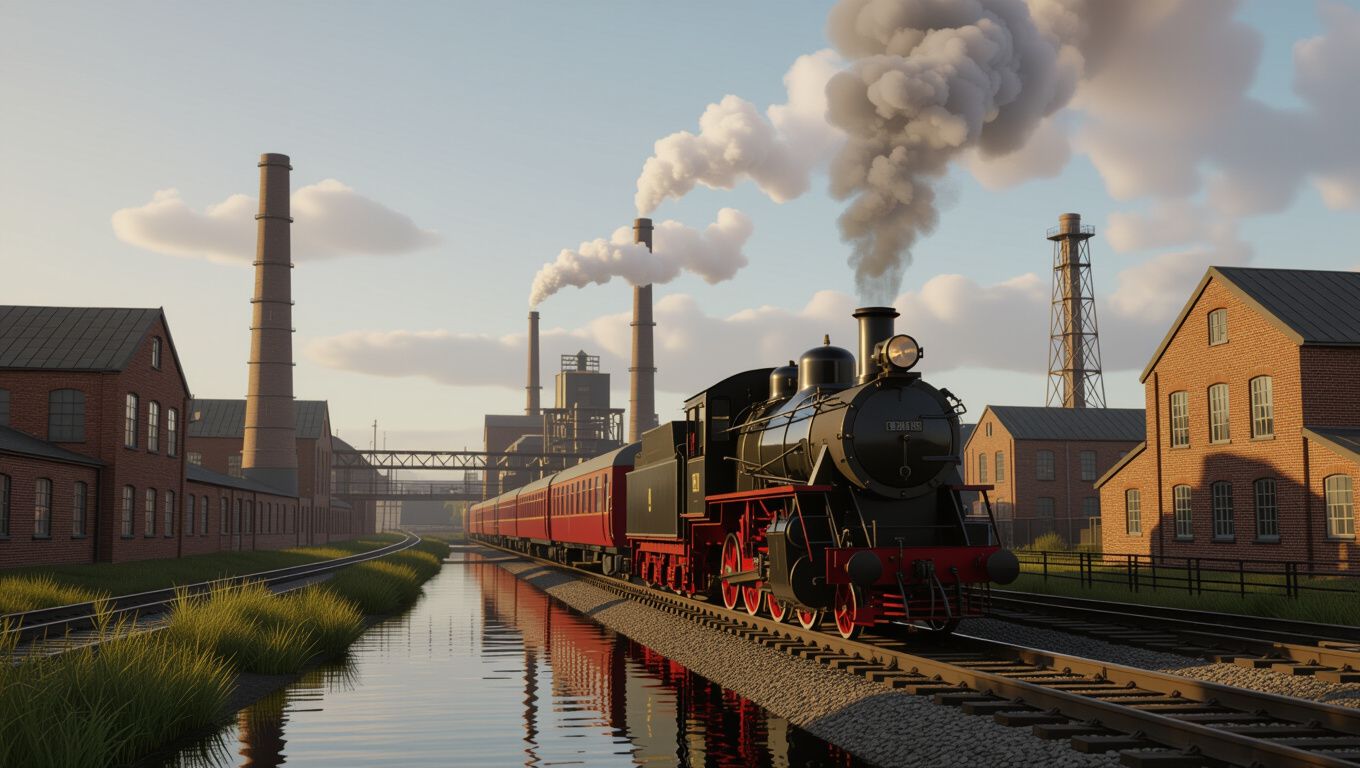
The iron and steel industry underwent similar transformation, with blast furnace improvements and rolling mills enabling production increases that supported railway construction, ship building, and machinery manufacturing. British iron production grew from 25,000 tons annually in 1700 to over 2 million tons by 1850, illustrating how mechanization compounded across linked industries. These iron products enabled further industrial expansion, creating positive feedback loops where each innovation enabled subsequent breakthroughs, accelerating overall industrial progress.
Railway Development as Industrial Catalyst
Railways emerged as perhaps the industrial revolution’s most transformative application, requiring massive iron production, engineering expertise, and coordinated labor forces on unprecedented scales. Current Trends and Ongoing Industrial Evolution
Modern manufacturing faces pressures analogous to those that drove the original industrial revolution, with digital technologies, artificial intelligence, and automation systems fundamentally reshaping production methods and labor requirements. Factories today employ robots and computer systems that would astound nineteenth-century observers, yet they address the same core challenges: increasing efficiency, reducing costs, and improving quality.
Future Challenges in Industrial Evolution
Environmental sustainability represents a fundamental challenge that historical industrial development largely ignored, with modern manufacturing under pressure to reduce carbon emissions, minimize waste, and protect ecosystems. Unlike historical industrialists focused purely on production maximization, contemporary businesses must balance growth with environmental stewardship, creating tensions between profitability and sustainability. These constraints require innovation equivalent to the market disruption from automation parallels the shortage ofalbour work concerns that emerged during the original industrial transition, though modern dynamics are reversed, factories need fewer workers while creating demands for high-skill technical employment. Nations and companies must invest substantially in worker retraining, education systems, and social support structures to manage transition periods. The businesses that succeed in navigating this modern industrial evolution will balance automation adoption with workforce development, maintaining social stability while capturing efficiency gains.
Comparison Table
The following table compares distinct industrial advancement periods, highlighting how technological innovation evolved and adapted across different manufacturing eras and industries.
The progression clearly demonstrates that technological innovation accelerates over time, with each industrial revolution arriving at shorter intervals and introducing more fundamental disruption than its predecessor.
Frequently Asked Questions About Industrial Revolution
What Exactly Was the Industrial Revolution?
The industrial revolution was the shift from handmade production to machine-based manufacturing between 1760 and 1840, beginning in Britain and transforming global economics.
How Did the Industrial Revolution Start and Why?
Agricultural improvements freed workers for factories, colonial trade provided materials and markets, and available capital enabled investment in steam-powered machinery and equipment.
What Challenges Did the Industrial Revolution Create?
Environmental pollution, dangerous working conditions, urban overcrowding, and economic disruption for traditional craftspeople reshaped societies during rapid industrialization periods.
Conclusion and Cta
The industrial revolution fundamentally reshaped human civilization, establishing manufacturing principles, business models, and organizational structures that continue defining modern enterprise today. Understanding this transformation provides essential context for contemporary business leaders navigating technological disruption, automation, and the ongoing evolution toward Industry 4.0. The lessons from this historical period, embracing technological innovation while managing social impacts, investing in workforce development, and balancing efficiency with sustainability, remain directly applicable to current business challenges and opportunities.
Begin exploring how industrial revolution principles apply to your organization by reviewing your current production systems, identifying automation opportunities, and assessing workforce development needs for emerging technologies. Visit business insights for current analysis of industrial trends and manufacturing innovation, then consult with industry experts about implementing modern production methodologies in your operations. Take action today to position your organization for competitive success in an era of accelerating technological change, ensuring your business strategy reflects lessons learned from centuries of industrial advancement.