About This Article
Explore the industrial revolution’s impact on manufacturing, technology, and society. Understand how mechanization reshaped global economies and created modern industries. Learn more below.
Introduction
The industrial revolution fundamentally reshaped human civilization between 1760 and 1840, transforming production methods from manual labor to machine-driven manufacturing. This period witnessed the output of British textile mills increase by over 300 percent, establishing the foundation for modern industrial economies. The industrial revolution emerged from a convergence of technological innovation, capital accumulation, and social change that would ripple across continents.
Understanding this pivotal era provides essential context for contemporary manufacturing practices and technological advancement. The principles established during this transformation continue to influence supply chains, automation strategies, and industrial design today. This article explores the mechanisms, impacts, and lasting legacy of the industrial revolution for modern audiences and professionals.
Table of Contents
Understanding the Industrial Revolution Era
The industrial revolution represents a distinct period when societies shifted from agrarian economies to machine-based manufacturing and factory systems. This transformation began in Britain around 1760, driven by technological breakthroughs like the steam engine, mechanized looms, and iron production advances. The industrial revolution enabled unprecedented production capacity, reducing costs and making goods accessible to populations that previously could not afford them.
The era’s defining characteristic was the substitution of human and animal power with mechanical energy derived from fossil fuels. Population growth, colonial trade expansion, and accumulated capital created favorable conditions for industrial development. Countries that embraced industrialization rapidly accumulated wealth and geopolitical power, establishing dominance that persisted for generations.
Steam Engine Innovation and Development
James Watt’s improved steam engine in 1769 became the cornerstone technology of the industrial revolution, providing reliable mechanical power for factories and transportation. This invention addressed critical energy needs that human workers and water wheels could not satisfy, enabling continuous production regardless of weather or seasonal conditions. The steam engine’s efficiency improvements reduced fuel consumption by up to 80 percent compared to earlier designs.
Steam-powered machinery spread rapidly across textile production, mining, and metalworking industries throughout the 1770s and 1780s. Factory owners invested heavily in steam infrastructure, driving demand for coal mining and iron production. This created interconnected industrial ecosystems where innovations in one sector directly benefited others, accelerating overall economic growth and technological progress.
Why the Industrial Revolution Remains Significant
The industrial revolution established the modern economic framework that continues structuring global commerce and manufacturing today. The principles of mass production, factory organization, and supply chain management originated during this period, fundamentally improving efficiency and reducing unit costs. Understanding this transformation provides insight into contemporary manufacturing challenges and opportunities in automation, sustainability, and workforce management.
This period fundamentally altered human society by creating urban centers, establishing working classes, and generating unprecedented wealth accumulation. The social structures, labor practices, and environmental impacts established during industrialization still influence policy debates, worker rights movements, and environmental regulations worldwide. Modern discussions about automation, artificial intelligence, and technological disruption often echo concerns first raised during the industrial revolution.
Economic Growth and Global Trade Expansion
Industrial nations experienced dramatic GDP growth during the 1800s, with Britain’s economic output increasing by over 1,200 percent between 1760 and 1860. This wealth enabled nations to dominate global trade networks, establish colonial markets for manufactured goods, and accumulate capital for further industrial investment. The competitive advantages created by industrial manufacturing persisted for over a century, establishing economic hierarchies that shaped international relations.
Manufactured goods produced in industrial factories displaced traditional artisan products in global markets, transforming trade relationships and creating economic dependencies. Nations that industrialized early gained technological advantages that competitors struggled to overcome, establishing patterns of industrial dominance lasting into the modern era. This phenomenon demonstrates how technological innovation creates lasting competitive advantages in global commerce and geopolitical influence.
How Industrial Manufacturing Systems Operated
Industrial manufacturing systems functioned through the organization of workers, machines, and raw materials within centralized factories powered by mechanical energy sources. Factory owners employed division of labor principles where workers performed specialized, repetitive tasks rather than crafting complete products individually. This organization dramatically increased output per worker while reducing skill requirements and enabling wage suppression that maximized profit margins.
The integration of coal-powered steam engines with mechanized machinery created production networks far exceeding human capacity. Raw materials moved through sequential processing stages where machines performed increasingly complex operations previously requiring master craftspeople. This systematic approach eliminated production bottlenecks, standardized product quality, and enabled economies of scale that made manufactured goods affordable to working-class consumers.
Factory Organization and Labor Discipline
Factory managers implemented strict discipline systems requiring workers to arrive at specific times, maintain consistent pace with textile mills and metalworks throughout the industrial period. Despite difficult conditions, factory employment attracted rural workers seeking income alternatives to agricultural labor, creating a substantial urban working class.
Child labor represented a significant component of industrial workforces, with children comprising up to 40 percent of workers in some textile factories. The mechanical simplicity of many factory tasks made child employment economically rational for manufacturers seeking to minimize labor costs. This practice eventually prompted social reform movements that established child labor restrictions, overtime limits, and workplace safety standards still protecting workers today.
Practical Historical Examples of Industrial Transformation
The British textile industry exemplifies how industrial revolution technologies transformed specific sectors from craft-based production to factory manufacturing. Hand spinning and weaving dominated before 1760, with skilled craftspeople controlling quality and production pace. The introduction of the spinning jenny in 1764, water frame in 1769, and power loom in 1785 mechanized every stage of textile production, increasing output per worker by over 200 percent while reducing skill requirements.
Factory towns like Manchester and Lancashire emerged around textile mills, illustrating how industrial development created entirely new urban centers and social structures. These communities housed thousands of workers and their families within walking distance of factories, establishing patterns of urban industrial development replicated globally. The transformation of Manchester from a village of 25,000 residents in 1772 to a city of 300,000 by 1850 demonstrates industrialization’s profound impact on population geography and urbanization patterns.
Iron and Steel Production Advancement
Improved iron smelting techniques using coke instead of charcoal dramatically increased production capacity while reducing fuel costs between 1709 and 1750. This innovation enabled manufacturers to produce larger quantities of higher-quality iron for machinery, rails, and construction, directly supporting industrial expansion across multiple sectors. Iron production increased from approximately 68,000 tons annually in 1750 to over 1 million tons by 1850 in Britain alone.
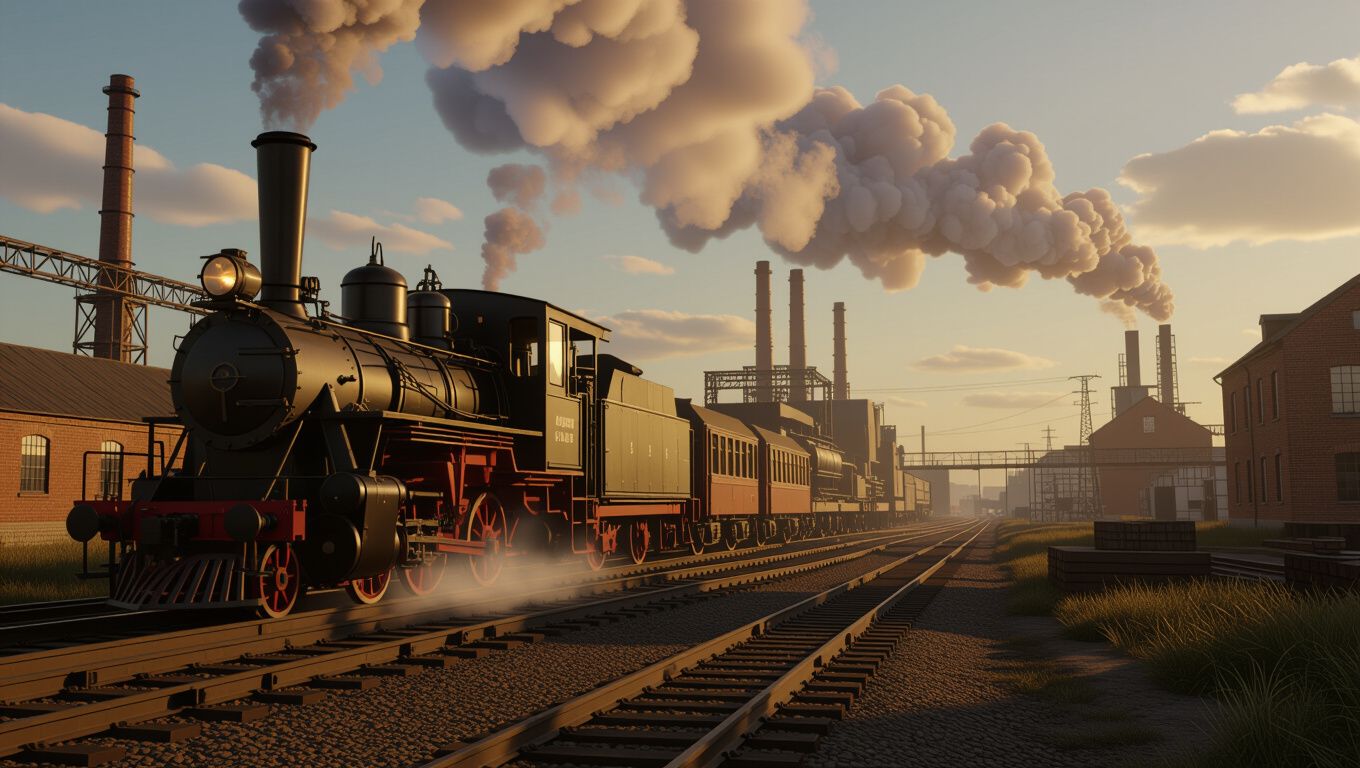
Enhanced iron availability enabled construction of larger steam engines, more robust machinery, and extensive railway networks that revolutionized transportation and logistics. Railways powered by steam locomotives connected factories to ports and markets, reducing transportation costs and enabling integration of geographically dispersed industrial operations. This infrastructure development created multiplier effects where transportation improvements stimulated demand for iron, coal, and engineering services that accelerated industrial growth.
Current Understanding and Lasting Industrial Legacy
Modern manufacturing still applies principles established during the industrial revolution, including mechanization, division of labor, and centralized factory production. Contemporary automation represents an extension of industrialization logic, replacing human workers with increasingly sophisticated machines that perform tasks with greater precision and consistency. The industrial revolution established the conceptual framework that guides modern supply chain management, quality control, and production optimization strategies.
Understanding the industrial revolution’s environmental and social costs informs contemporary debates about sustainability, worker welfare, and technological responsibility. The period’s rapid industrialization created severe air and water pollution, hazardous working conditions, and extreme income inequality that motivated subsequent social reform movements. These historical lessons shape modern environmental regulations, labor standards, and corporate responsibility initiatives addressing technology’s societal impacts.
Transition to Modern Manufacturing Systems
The assembly line innovation pioneered by Henry Ford in 1913 represented the industrial revolution’s logical evolution, applying mechanization principles to automobile production with unprecedented efficiency. This system dramatically reduced vehicle production time from 728 hours in 1912 to 93 hours by 1914, making automobiles affordable for middle-class consumers. Ford’s approach became the global manufacturing standard, demonstrating how industrial revolution principles continued driving innovation and productivity improvements throughout the twentieth century.
Contemporary manufacturing incorporates digital technologies, robotics, and artificial intelligence as evolutionary extensions of industrial revolution mechanization. Industry 4.0 concepts like smart factories and interconnected machinery represent advanced applications of the same logic that motivated steam engine adoption in 1760. The fundamental principle of replacing human labor with machines to reduce costs and increase output remains central to modern manufacturing strategy and industrial investment.
Comparison Table
The following table compares distinct phases of industrial development, illustrating how manufacturing approaches evolved from the initial industrial revolution through modern practices.
The comparison illustrates how manufacturing technology evolved progressively from mechanical automation toward
Frequently Asked Questions About Industrial Revolution
What Exactly Defines the Industrial Revolution Period?
The industrial revolution represents the shift from agrarian economies to machine-based manufacturing spanning approximately 1760 to 1840 in Britain and beyond.
How Did the Industrial Revolution Improve Manufacturing Efficiency?
Mechanization through steam engines and specialized machinery increased production output per worker by 200 to 300 percent while reducing unit costs substantially.
What Environmental Problems Resulted From Industrialization?
Rapid coal burning and factory production created severe air pollution, water contamination, and waste problems affecting urban areas surrounding industrial centers.
Conclusion and Cta
The industrial revolution fundamentally transformed human society by introducing mechanized manufacturing, establishing modern factory systems, and creating the economic frameworks that continue structuring global commerce today. This transformative period demonstrates how technological innovation creates lasting competitive advantages while generating significant social and environmental challenges requiring thoughtful management. Understanding this historical transformation provides valuable perspective for addressing contemporary challenges in automation, workforce development, and sustainable manufacturing practices.
Deepen your knowledge of industrial advancement by exploring latest technology news for modern manufacturing insights and innovation trends. Start by reading one comprehensive historical source this week, then examine how industrial revolution principles apply to your industry or profession.