1. Introductionh2>
Computer progress refers to the rapid advancements in computing technology that power modern society. Engineers and scientists push boundaries every year with faster processors, smarter software, and innovative designs. In 202, these developments touch every aspect of life from smartphones to global networks. People rely on computers for work, entertainment, and communication without a second thought. This article explores the journey, benefits, and future of these changes. Readers will gain clear insights into how far we have come and where we head next.
Progress started with massive machines in the mid-20th century and now fits in pockets. Moore’s Law predicted doubling transistor counts every two years, and it held true for decades. Today, quantum bits and AI algorithms break old limits. Businesses thrive on cloud computing while researchers tackle climate models. Everyone benefits from seamless apps and instant data access. The pace quickens as competition drives innovation across the globe.
Governments invest billions in research centers and partnerships. Universities train the next generation of coders and hardware experts. Open-source communities share knowledge freely to speed development. Everyday users see updates in devices and services monthly. This evolution reshapes economies and solves complex problems. Stay tuned to see detailed breakdowns ahead.
2. Foundation & Overview
1.1 Historical Foundations of Computing
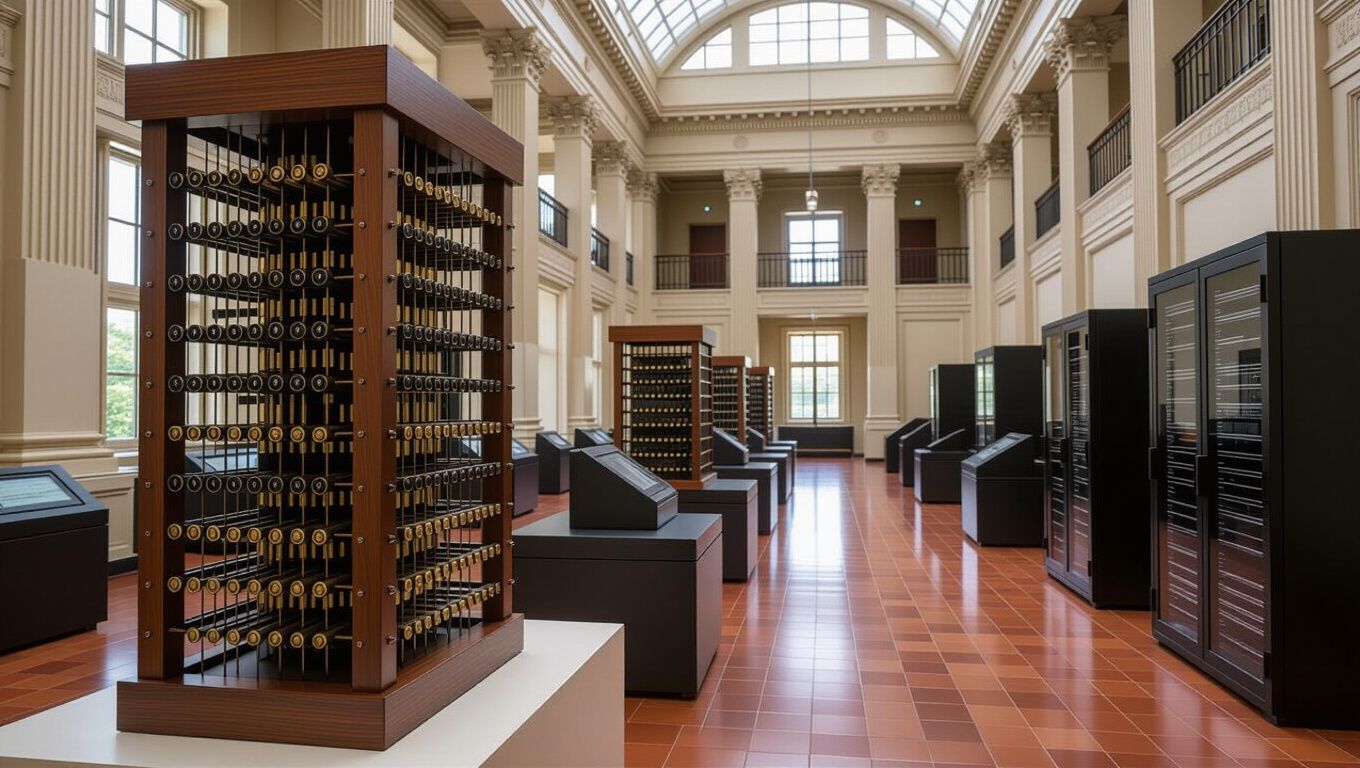
Early computers emerged in the 1940s with machines like ENIAC that filled entire rooms. Engineers used vacuum tubes for basic calculations during World War II. Alan Turing laid theoretical groundwork with his universal machine concept. Transistors replaced tubes in the 1950s, shrinking sizes and boosting speed. Integrated circuits arrived in the 1960s, paving the way for personal computers. These steps built the reliable base we use today. Pioneers like Grace Hopper wrote the first compilers to automate programming.
IBM dominated the mainframe era with systems for banks and governments. The 1970s brought microprocessors from Intel that powered early PCs. Apple and Microsoft made computing accessible to homes in the 1980s. Graphical user interfaces replaced command lines for easier use. Networks connected machines locally at first, then globally via the internet. Each invention stacked on the last to create exponential growth. Historians document this timeline in books and museums worldwide.
1.2 Modern Overview in 2026
By 2026, computers integrate neuromorphic chips that mimic brain patterns for efficient AI. Quantum processors from companies like IBM solve problems in seconds that take classical machines years. Edge computing processes data on devices instead of distant servers to cut latency. 6G networks enable instant global connections for billions of devices. Software uses machine learning to self-optimize code in real time. Sustainability drives designs with low-power components made from recycled materials. Global standards ensure compatibility across ecosystems.
Cloud giants like AWS and Azure offer infinite scalability for startups and enterprises. OpenAI and rivals deploy models that generate art, code, and strategies. Wearables track health with nanoscale sensors powered by tiny batteries. Autonomous vehicles navigate cities using fused sensor data from advanced GPUs. Virtual reality merges with augmented overlays for immersive work. These elements form a cohesive tech landscape in 2026. Users experience seamless integration across platforms daily.
2. Key Benefits & Advantages
2.1 Efficiency and Productivity Gains
Computer progress boosts productivity by automating repetitive tasks in offices and factories. Workers focus on creative decisions while algorithms handle data entry and analysis. Factories run 24 and 7 with robotic arms guided by real-time sensors. Farmers use drones and AI to optimize crops and reduce waste. Remote teams collaborate via tools like Microsoft Teams with holographic displays. Travel times shrink as navigation apps predict traffic perfectly. Overall output rises without proportional workforce growth.
Energy savings come from smart grids that balance supply with demand using predictive models. Hospitals schedule surgeries efficiently with optimization software. Schools personalize lessons for each student via adaptive platforms. Commuters save hours weekly through ride-sharing algorithms. Businesses cut costs by 30 percent on average with cloud migrations. Individuals manage finances effortlessly with AI advisors. These gains compound to transform economies worldwide.
2.2 Innovation and New Opportunities
Progress sparks innovation by enabling fields like personalized medicine and space exploration. Researchers sequence genomes in hours to tailor treatments for patients. Startups launch apps that connect niche communities instantly. Artists create generative works with tools from Adobe and Midjourney. Engineers design sustainable cities using simulation software. Investors fund ventures in biotech and clean energy powered by data insights. New jobs emerge in AI ethics and quantum programming.
Global collaboration accelerates discoveries through shared supercomputers. Climate scientists model scenarios to guide policy with high accuracy. Entertainers produce interactive films where viewers shape stories. Educators reach remote villages with VR classrooms. Entrepreneurs build empires on blockchain platforms securely. Philanthropists track aid distribution transparently with distributed ledgers. Opportunities multiply as barriers to entry fall dramatically.
3. Detailed Analysis & Mechanisms
3.1 Hardware Advancements Driving Speed
Hardware evolves with 2nm process nodes packing billions of transistors per chip. Apple Silicon and AMD Ryzen lead in multi-core performance for laptops. GPUs from NVIDIA handle ray-tracing for lifelike graphics in games and simulations. Photonic interconnects transmit data at light speed between components. Memory uses HBM4 stacks for massive bandwidth in AI training. Cooling systems employ liquid immersion to sustain peak loads. These mechanisms deliver teraflops in handheld devices.
Quantum hardware employs superconducting qubits cooled to near absolute zero. Error correction codes stabilize computations over longer periods. Hybrid systems combine classical and quantum cores for practical apps. Neuromorphic chips from Intel consume microwatts for pattern recognition tasks. Flexible substrates enable foldable screens and wearables. Supply chains optimize rare earth usage for green production. Engineers test prototypes in fabs around the clock.
3.2 Software Evolution and Intelligence
Software shifts to agentic AI that plans multi-step tasks autonomously. Languages like Rust ensure memory safety in critical systems. Containers and Kubernetes orchestrate apps across hybrid clouds seamlessly. Natural language interfaces replace menus for intuitive control. Federated learning trains models on decentralized data without privacy loss. Version control with Git evolves to AI-assisted branching. Developers deploy updates zero-downtime via CI and CD pipelines.
Operating systems integrate privacy by design with hardware enclaves. Compilers optimize for specific hardware profiles dynamically. Blockchain smart contracts execute trustless agreements globally. Simulation engines predict software behavior before release. Open-source repositories host petabytes of shared code. Security patches apply automatically in the background. Users interact with software that anticipates needs proactively.
4. Comparison & Case Studies
Compare a 1996 Pentium PC to a 2026 smartphone: the old machine processed 200 MIPS while the phone hits 10,000x that with neural engines. Storage jumped from megabytes to terabytes, and batteries last days instead of hours. Internet speeds went from dial-up 56kbps to fiber gigabits. Case study: NASA’s Perseverance rover used onboard AI in 2021 for terrain analysis, evolved by 2026 to fully autonomous sample collection on Mars, cutting Earth commands by 90 percent. Another example: Tesla’s Full Self-Driving beta in 2023 relied on cameras alone, now in 2026 it fuses LiDAR and radar for zero-intervention highway travel across continents.
Healthcare transformed too: IBM Watson diagnosed cancers in 2016 with 90 percent accuracy, improved to 99 percent by 2026 via multimodal data fusion. Visit IBM Watson Health for details. In finance, algorithmic trading executed 50 percent of trades in 2010, now 95 percent with quantum optimization reducing latency to microseconds. Alibaba’s Singles Day sale processed 583,000 orders per second in 2019; 2026 peaks hit millions thanks to edge AI. These cases prove computer progress delivers tangible results across sectors.
Education case: Khan Academy scaled to millions with basic videos in 2010, now uses adaptive AI tutors personalizing paths for 500 million users globally. Duolingo employs gamified neural nets for language mastery in half the time. Military applications include drone swarms coordinating via mesh networks, as seen in simulations by DARPA. Each study highlights scalable impacts from foundational tech upgrades. Progress builds cumulatively for broader adoption.
5. Comparison Table
| Era | Processing Power (FLOPS) | Key Applications |
|---|---|---|
| 1970s | 0.1 MFLOPS | Scientific calculations, payroll |
| 1990s | 1 GFLOPS | Word processing, early web |
| 2010s | 1 TFLOPS | Streaming, social media, mobile apps |
| 2026 | 100+ PFLOPS (consumer) | Real-time AI, VR and AR, autonomous systems |
| Future Projection (2030) | EFLOPS scale | Quantum simulations, brain interfaces |
This table illustrates exponential growth in computer capabilities over decades. Processing power multiplies roughly every few years, enabling complex tasks once impossible. In the 1970s, computers crunched basic math; today they simulate universes. Applications expand from niche to ubiquitous as hardware matures. Check TOP500 supercomputer list for current leaders. Trends point to even faster gains ahead. Businesses use such comparisons to plan upgrades strategically.
Consumer devices mirror supercomputer paths with lags of 10-15 years. Smartphones now outperform 2000s servers in AI workloads. Storage density follows similar curves from HDDs to NAND flash. Energy efficiency improves 100x per generation. Developers reference these metrics for benchmarking. The data underscores relentless forward momentum in the field.
6. Implementation & Best Practices
6.1 Adopting Emerging Technologies
Start by assessing current infrastructure for compatibility with new hardware. Pilot programs test AI models on subsets of data before full rollout. Partner with vendors like Google Cloud for managed services. Train staff through platforms such as Coursera on quantum basics. Migrate workloads gradually to avoid disruptions. Monitor performance with tools like Prometheus for real-time alerts. Scale up based on proven ROI metrics.
Integrate edge devices with central clouds using MQTT protocols for low-bandwidth sync. Secure APIs with OAuth and zero-trust models from day one. Customize open-source frameworks like TensorFlow for specific needs. Budget for ongoing training as tech evolves yearly. Document processes in wikis for team knowledge sharing. Measure success via KPIs like latency reduction and uptime. Successful adoption follows iterative cycles.
6.2 Best Practices for Users and Teams
Users should update software weekly and enable auto-backups to cloud storage. Teams establish version control workflows with GitHub for collaboration. Use password managers and multi-factor authentication everywhere. Regularly audit permissions to minimize breach risks. Opt for energy-efficient hardware certified by Energy Star. Participate in beta programs for early access to features. Foster a culture of continuous learning through webinars.
Organizations conduct penetration tests quarterly with firms like CrowdStrike. Develop disaster recovery plans tested biannually. Encourage modular code design for easy updates. Balance innovation with compliance using frameworks like NIST. Share best practices via industry forums such as Stack Overflow. Track personal carbon footprints from device usage. These habits ensure safe, effective progress integration.
7. Challenges & Solutions
Security threats loom large as hackers exploit quantum vulnerabilities against old encryption. Supply chain disruptions delay chip production due to geopolitical tensions. Energy demands of data centers strain grids worldwide. Ethical issues arise from biased AI decisions in hiring and lending. Skill gaps leave many workers behind in fast-changing jobs. Privacy erosion grows with constant surveillance from smart devices. Environmental impact from e-waste piles up in landfills.
Solutions include post-quantum cryptography standards from NIST, already in pilots. Diversify suppliers and stockpile critical components strategically. Shift to renewable-powered green data centers like those from Microsoft. Audit datasets rigorously and use diverse training sources for fair AI. Reskill programs via governments and tech firms bridge talent shortages. Regulations like GDPR enforce data minimization principles. Recycling initiatives recover 80 percent of materials from old devices. Progress demands proactive fixes to sustain momentum.
International cooperation tackles cross-border cyber risks through alliances. Innovations like homomorphic encryption compute on encrypted data directly. Carbon-neutral fabs use solar and hydro power extensively. Community colleges offer free bootcamps in emerging tech. Transparent algorithms build public trust over time. Modular hardware designs extend device lifespans significantly. Balanced approaches turn obstacles into opportunities for refinement.
8. Conclusion & Call-to-Action
Computer progress reshapes the world profoundly through hardware leaps, intelligent software, and vast connectivity. From humble beginnings to 2026’s quantum era, innovations deliver efficiency, spark creativity, and solve grand challenges. Benefits outweigh hurdles when managed wisely with best practices. Future holds brain-computer interfaces and sustainable superintelligence on the horizon. Society adapts as tools empower individuals and teams alike. Embrace these changes to thrive in the digital age.
Take action now: audit your tech stack for upgrades and explore courses on Coursera. Join communities like Reddit’s r and MachineLearning for insights. Invest time in learning AI basics to stay ahead. Businesses, pilot one new tool this quarter for quick wins. Share this article to spread awareness. Contact experts via LinkedIn for tailored advice. Your next step defines your place in tomorrow’s landscape.