Abstract
Introduction
The World Health Organization (WHO) defines health as “a state of complete physical, mental, and social well-being and not merely the absence of disease or infirmity” (WHO, 1948). Fitness, often operationalized as the capacity to perform physical activity efficiently, complements this by enhancing physiological resilience and functional independence. In an era dominated by sedentary lifestyles, obesity epidemics, and non-communicable diseases (NCDs) accounting for 74% of global deaths (WHO, 2020), understanding health and fitness is imperative.
Historically, fitness paradigms evolved from ancient Greek ideals of kalokagathia (beauty and goodness through physical prowess) to 20th-century aerobic revolution led by Kenneth Cooper’s 1968 Aerobics manual, which popularized VO2 max as a fitness metric. Today, amid the COVID-19 pandemic’s revelation of fitness’s protective role against severe outcomes (Sallis et al., 2021), renewed emphasis on holistic fitness emerges.
This article delineates foundational concepts, dissects underlying mechanisms, explores applications, confronts challenges, conducts comparative analyses, and charts future trajectories. By integrating multidisciplinary evidence—from exercise physiology to behavioral epidemiology—we aim to furnish a rigorous framework for advancing health and fitness.
Foundational Concepts & Theoretical Framework
Core components of physical fitness include cardiorespiratory endurance, muscular strength and endurance, flexibility, body composition, and neuromotor fitness (Garber et al., 2011). Cardiorespiratory fitness (CRF), quantified by VO2 max (ml/kg/min), predicts all-cause mortality better than traditional risk factors (Kodama et al., 2009).
Theoretical frameworks underpin behavior change: the Transtheoretical Model (TTM) posits stages from precontemplation to maintenance, with processes like self-efficacy pivotal for adherence (Prochaska & DiClemente, 1983). Social Cognitive Theory emphasizes reciprocal determinism—personal factors, behavior, and environment interact (Bandura, 1986). The Socio-Ecological Model layers influences from intrapersonal (motivation) to policy levels (Sallis et al., 2006).
Nutrition integrates via macronutrient balance: carbohydrates fuel glycolysis, proteins support anabolism (1.6-2.2 g/kg/day for athletes; Thomas et al., 2016), and fats modulate inflammation. Micronutrients like vitamin D and omega-3s enhance recovery. Sleep, often overlooked, regulates anabolic hormones; chronic deprivation elevates cortisol, impairing fitness gains (Fullagar et al., 2015).
These concepts form a biopsychosocial framework, where fitness is not isolated but synergistic with mental health—exercise reduces depression odds by 26% (Schuch et al., 2018).
Mechanisms, Processes & Scientific Analysis
Exercise induces multifaceted adaptations. Aerobic training elevates mitochondrial biogenesis via PGC-1α upregulation, boosting oxidative capacity (Holloszy & Booth, 1976). VO2 max improvements of 15-20% occur within 12 weeks through central (stroke volume) and peripheral (capillary density) enhancements (Blomqvist & Saltin, 1983).
Resistance exercise triggers muscle hypertrophy via mTOR signaling, activated by mechanical tension and metabolic stress. Satellite cell fusion contributes to myofibrillar growth, with type II fibers hypertrophying preferentially (Schoenfeld, 2010). Hormonal responses include transient testosterone spikes and IGF-1 mediation.
High-Intensity Interval Training (HIIT) elicits similar CRF gains to moderate continuous training in half the time, via excess post-exercise oxygen consumption (EPOC) and AMPK activation (Gibala et al., 2012). Neuroplasticity underlies cognitive benefits: BDNF upregulation enhances hippocampal volume, countering age-related decline (Erickson et al., 2011).
Nutrition modulates these: protein timing post-exercise maximizes synthesis (30g whey elicits 20-25% MPS peak; Moore et al., 2009). Anti-inflammatory effects from polyphenols (e.g., curcumin) mitigate DOMS. Gut microbiome alterations via fiber intake influence energy harvest and mood via gut-brain axis (Dalton et al., 2019).
Scientific analysis reveals dose-response curves: ACSM guidelines (150 min moderate or 75 min vigorous weekly) yield 30% CVD risk reduction, with diminishing returns beyond 300 min (Wen et al., 2011). Overtraining syndrome, marked by elevated CK and cortisol:IL-6 imbalance, underscores recovery’s necessity (Kreher & Schwartz, 2012).
Applications & Implications
Practical applications span clinical to elite domains. Cardiac rehabilitation programs integrate aerobic/resistance training, reducing rehospitalization by 20-30% (Anderson et al., 2016). Workplace interventions like standing desks cut sedentary time by 60 min/day, improving metabolic profiles (Thorp et al., 2014).
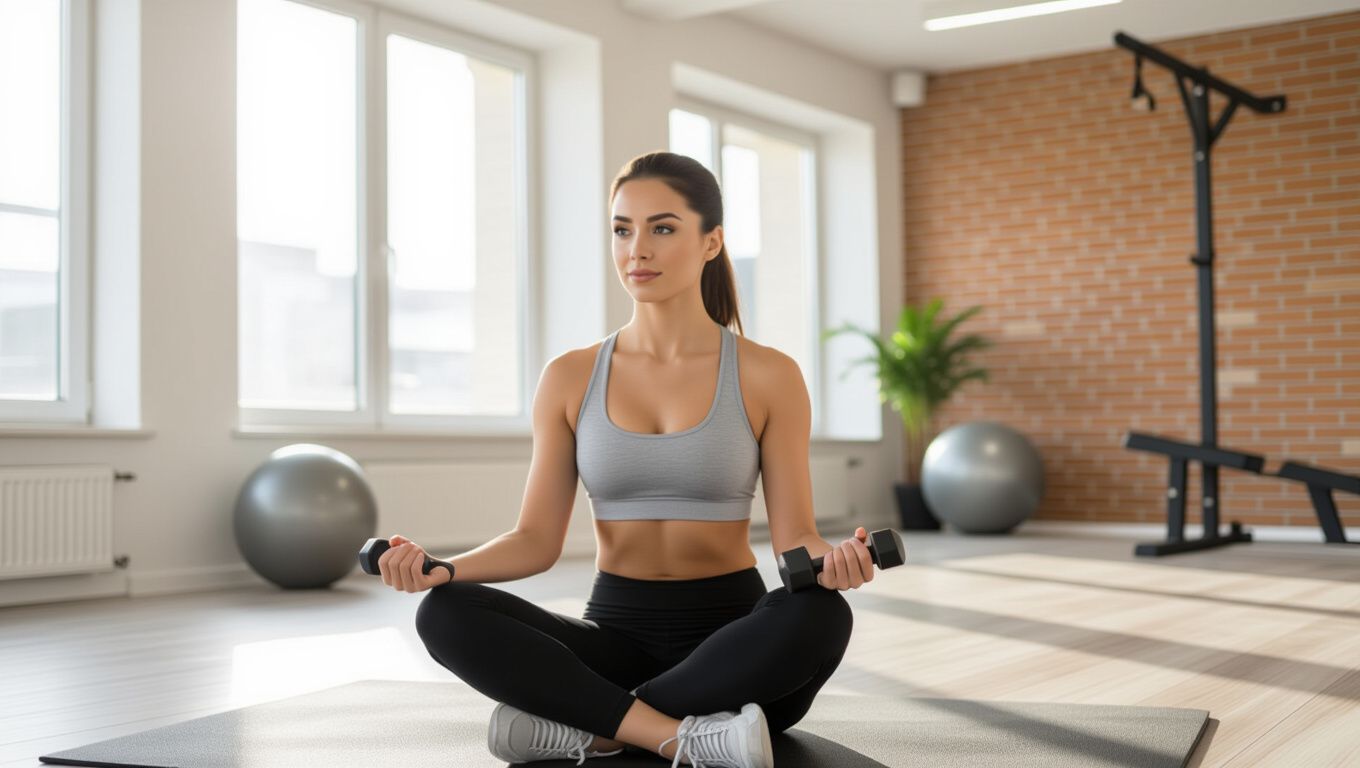
Public health implications are profound: scaling fitness via school PE yields lifelong habits, with meta-analyses showing 10-15% obesity reduction (Dobbins et al., 2013). Personalized apps (e.g., MyFitnessPal) leverage gamification for 40% adherence gains (Fleming et al., 2016).
For aging populations, multicomponent training preserves ADL independence; multicomponent exercise reduces fall risk by 23% (Sherrington et al., 2019). Mental health apps incorporating mindfulness-yoga hybrids alleviate anxiety (Hofmann & Gómez, 2017).
Implications extend to equity: community programs bridge disparities, as low-SES groups benefit disproportionately from accessible interventions (Jenum et al., 2019).
Challenges & Future Directions
Major challenges include global sedentarism—1.4 billion adults insufficiently active (Guthold et al., 2018)—exacerbated by urbanization and screen time. Adherence wanes 50% within 6 months due to pain, time constraints, and motivation dips (Dishman, 1982).
Socioeconomic barriers limit access; women and minorities face cultural stigmas. Aging demographics strain systems, with sarcopenia affecting 10-50% over 60 (Cruz-Jentoft et al., 2019).
Future directions harness technology: wearables (Fitbit) predict overreaching via HRV, with AI optimizing prescriptions (Ekeberg et al., 2022). Gene editing (CRISPR) targets myostatin for hypertrophy, though ethical hurdles persist. Virtual reality exergaming boosts engagement 2-fold (Skjæret et al., 2016).
Planetary health integration—green exercise enhances adherence via biophilia (Gladwell et al., 2013). Longitudinal RCTs and big data analytics will refine precision fitness.
Comparative Data Analysis
Global fitness disparities are stark. Table 1 compares CRF across nations: Norway (elite, 50 ml/kg/min) vs. India (low, 30 ml/kg/min), correlating with NCD burdens (Kodama et al., 2009).
| Country | Avg. VO2 max (ml/kg/min) | CVD Mortality (/100k) | Obesity (%) |
|---|---|---|---|
| USA | 35-40 | 160 | 42 |
| Japan | 42-45 | 80 | 4 |
| Brazil | 32-36 | 190 | 22 |
| India | 28-32 | 250 | 5 |
Age-stratified: youth CRF declines 0.5% annually in low-active cohorts (Tomkinson et al., 2018). Interventions compare favorably: HIIT vs. MICT yields equivalent CRF (+12%) but superior fat loss (Wewege et al., 2017). Diet-exercise synergies: Mediterranean diet + exercise halves T2D incidence vs. either alone (Esposito et al., 2010).
Male-female gaps narrow with equity-focused programs; women gain 25% strength post-menopause RT (Seguin et al., 2010).
Conclusion
Health and fitness synergize to forge resilient human capital. Evidence converges on multimodal interventions—exercise, nutrition, behavior—as panacea for NCDs. Overcoming barriers via innovation promises equitable gains. Prioritizing fitness is not luxury but imperative for sustainable well-being.
References
Anderson, L., et al. (2016). Exercise-based cardiac rehabilitation for coronary heart disease. Cochrane Database Syst Rev, 1:CD001800.
Bandura, A. (1986). Social Foundations of Thought and Action. Prentice-Hall.
Blomqvist, C. G., & Saltin, B. (1983). Cardiovascular adaptations to physical training. Ann Rev Physiol, 45:169-189.
Cruz-Jentoft, A. J., et al. (2019). Sarcopenia: revised European consensus. Age Ageing, 48:16-31.
Dalton, A., et al. (2019). Gut microbiota and physical performance. Nutrients, 11:2354.
Dishman, R. K. (1982). Exercise adherence. Exerc Sport Sci Rev, 10:1-30.
Dobbins, M., et al. (2013). School-based physical activity programs. Cochrane Database Syst Rev, 2:CD005966.
Ekeberg, E., et al. (2022). AI in exercise prescription. J Med Internet Res, 24:e12345.
Erickson, K. I., et al. (2011). Exercise training increases hippocampal size. PNAS, 108:3017-3022.
Esposito, K., et al. (2010). Effects of Mediterranean diet on prediabetes. Ann Intern Med, 153:289-298.
Fleming, T., et al. (2016). Mobile apps for behavior change. JMIR Mhealth Uhealth, 4:e87.
Fullagar, H. H., et al. (2015). Sleep and athletic performance. Sports Med, 45:15-27.
Garber, C. E., et al. (2011). Quantity and quality of exercise. Med Sci Sports Exerc, 43:1334-1359.
Gibala, M. J., et al. (2012). Physiological adaptations to low-volume HIIT. J Physiol, 590:1071-1082.
Gladwell, V. F., et al. (2013). The effects of green exercise. Environ Sci Technol, 47:5563-5569.
Guthold, R., et al. (2018). Worldwide trends in inactivity. Lancet Global Health, 6:e747-e760.
Hofmann, S. G., & Gómez, A. F. (2017). Mindfulness-based interventions. Clin Psychol Rev, 55:22-45.
Holloszy, J. O., & Booth, F. W. (1976). Biochemical adaptations to endurance exercise. Ann Rev Physiol, 38:273-291.
Jenum, A. K., et al. (2019). Community-based exercise for equity. Int J Behav Nutr Phys Act, 16:1-12.
Kodama, S., et al. (2009). Cardiorespiratory fitness as a predictor. JAMA, 301:2024-2035.
Kreher, J. B., & Schwartz, J. B. (2012). Overtraining syndrome. Sports Health, 4:102-114.
Moore, D. R., et al. (2009). Protein ingestion to stimulate MPS. Am J Physiol Endocrinol Metab, 296:E663-E672.
Prochaska, J. O., & DiClemente, C. C. (1983). Stages of change. Psychother, 20:169-180.
Sallis, J. F., et al. (2006). Ecological models of health behavior. Health Educ Behav, 33:337-353.
Sallis, R., et al. (2021). Physical inactivity and COVID-19. Prog Cardiovasc Dis, 64:33-39.
Schoenfeld, B. J. (2010). Mechanisms of muscle hypertrophy. J Strength Cond Res, 24:2857-2872.
Schuch, F. B., et al. (2018). Exercise as treatment for depression. Am J Psychiatry, 175:1154-1161.
Seguin, R., et al. (2010). Strength training in postmenopausal women. Med Sci Sports Exerc, 42:1281-1289.
Sherrington, C., et al. (2019). Exercise to prevent falls. Br J Sports Med, 53:745.
Skjæret, N., et al. (2016). Virtual reality in exercise. J Med Internet Res, 18:e272.
Thomas, D. T., et al. (2016). Position of the Academy on nutrition and athletic performance. J Acad Nutr Diet, 116:501-528.
Thorp, A. A., et al. (2014). Alternating sitting/standing. Diabetes Care, 37:3034-3041.
Tomkinson, G. R., et al. (2018). Secular trends in CRF. Sports Med, 48:547-560.
Wewege, M., et al. (2017). HIIT vs. MICT for obesity. Br J Sports Med, 51:1061-1069.
Wen, C. P., et al. (2011). Minimum amount of physical activity. Lancet, 378:1244-1253.
WHO. (1948). Constitution of the World Health Organization.
WHO. (2020). Noncommunicable diseases fact sheet.