Abstract/Executive Summary
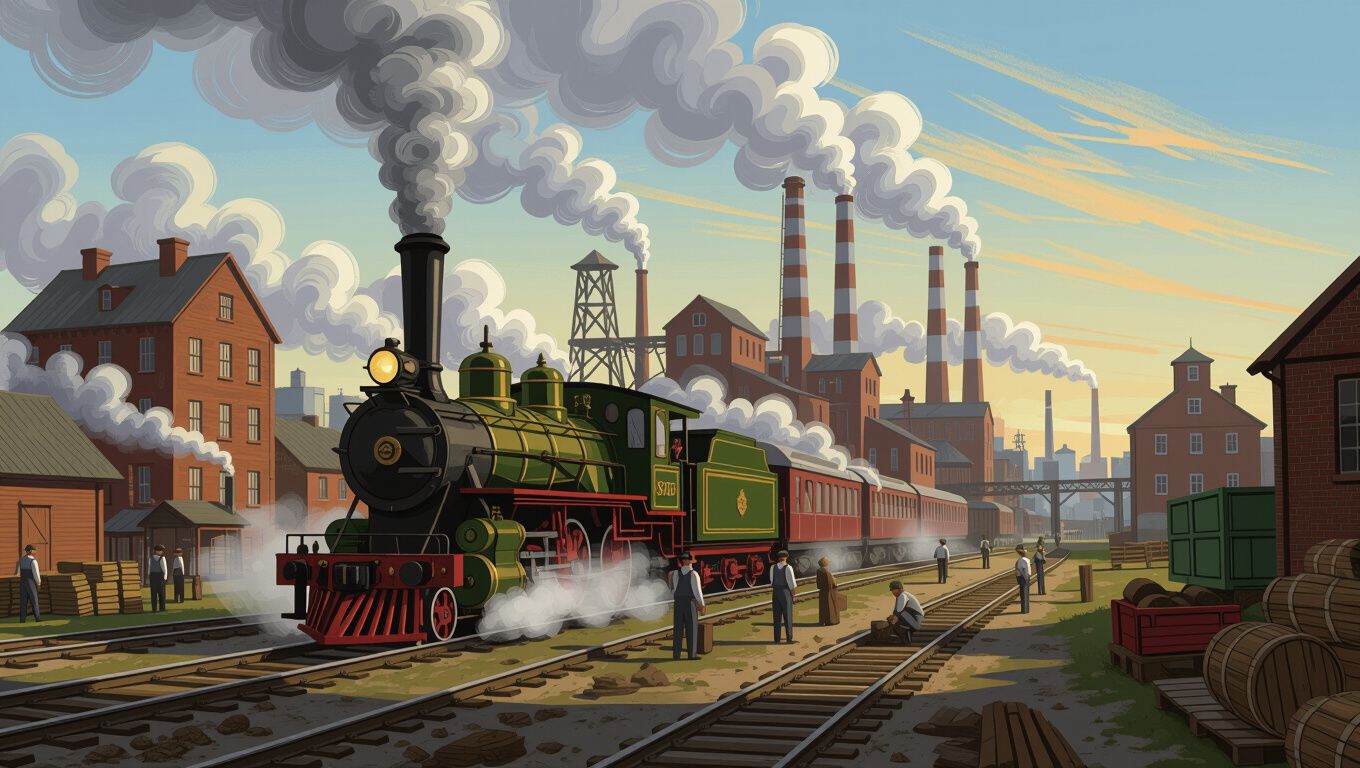
The Industrial Revolution, commencing in late eighteenth-century Britain, fundamentally transformed global economic structures through mechanized production and energy innovations, marking a pivotal shift from agrarian to industrial economies. This article elucidates the Industrial Revolution’s core dynamics, analyzing its foundational technologies such as the steam engine and textile machinery, which propelled unprecedented productivity gains. Mechanisms of the Industrial Revolution, including factory systems and capital accumulation, are dissected to reveal their role in urbanization and demographic transitions. Implications of the Industrial Revolution extend to social stratification, imperial expansion, and environmental alterations, while challenges like labor exploitation and pollution foreshadowed regulatory evolutions. A comparative analysis underscores the Industrial Revolution’s phased progression, culminating in its enduring legacy as the archetype of technological revolutions.
Introduction
The Industrial Revolution, originating in Britain around 1760 and extending through the nineteenth century, represented a profound reconfiguration of production methods, energy utilization, and societal organization. This epochal shift, often delineated as the First Industrial Revolution, was characterized by the substitution of human and animal labor with machine-based processes powered by fossil fuels. The Industrial Revolution’s inception in Britain was facilitated by abundant coal reserves, colonial markets, and institutional frameworks supportive of innovation. Key metrics of the Industrial Revolution include a tenfold increase in per capita output in Britain by 1850, alongside exponential growth in iron production and cotton consumption. This introduction frames the Industrial Revolution as a multifaceted phenomenon, intertwining technological, economic, and social threads that reshaped human existence.
Subsequent diffusion of the Industrial Revolution to continental Europe and North America amplified its global ramifications, with variations in timing and intensity reflecting local resource endowments and policy environments. The Industrial Revolution’s historiography, from Toynbee’s early formulations to contemporary cliometric analyses, underscores its non-linear progression and contingent nature. Understanding the Industrial Revolution requires integrating quantitative data on GDP growth—averaging 1-2% annually during its peak—with qualitative insights into cultural adaptations.
Foundational Concepts
At the heart of the Industrial Revolution lay foundational concepts of mechanization and energy harnessing, epitomized by James Watt’s steam engine improvements in 1769, which boosted efficiency by 75% over Newcomen’s model. The Industrial Revolution’s textile sector innovations, including Arkwright’s water frame (1769) and Crompton’s mule (1779), enabled continuous production, reducing yarn costs by 90% within decades. These concepts were underpinned by empirical science, with figures like Black and Lavoisier elucidating combustion principles critical to steam power in the Industrial Revolution.
Economically, the Industrial Revolution rested on concepts of division of labor and capital investment, as theorized by Adam Smith in 1776, where pin factory analogies prefigured assembly lines. Enclosure Acts in Britain, consolidating 21% of arable land by 1820, displaced agrarian labor, channeling it into Industrial Revolution factories. Demographically, the Industrial Revolution’s concepts involved fertility declines and migration patterns, with urban populations surging from 20% to 50% in England by 1851.
Mechanisms & Analysis
The mechanisms of the Industrial Revolution operated through a synergy of technological diffusion and market expansion, wherein steam engines proliferated from 15 in 1775 to 2,100 by 1800 in Britain alone. Factory systems, as analyzed by Marx in Capital, centralized labor under capitalist control, yielding economies of scale that doubled productivity per worker. Quantitative analysis reveals the Industrial Revolution’s growth accounting: total factor productivity rose 0.4% annually, driven by capital deepening and human capital accumulation via rudimentary schooling.
Transportation mechanisms, including canals (e.g., Bridgewater, 1761) and railways (Stockton-Darlington, 1825), reduced freight costs by 50-70%, integrating national markets central to the Industrial Revolution. Econometric models, such as Crafts’ revisions, attribute 35% of Britain’s Industrial Revolution growth to cotton textiles, with coal mining mechanization via steam pumps preventing inundations. Social mechanisms involved proletarianization, where wage labor supplanted artisanal guilds, fostering class antagonisms analyzed through Gini coefficient increases from 0.45 to 0.55.
Applications & Implications
Applications of the Industrial Revolution extended to iron and steel via puddling (1784) and Bessemer processes (1856), elevating output from 68,000 tons in 1788 to 7.7 million by 1870 in Britain. These propelled machinery construction, amplifying the Industrial Revolution’s recursive innovations. Implications included imperial trade networks, with Britain’s cotton imports rising from 0.5 to 32 million pounds (1760-1800), fueling colonial exploitation intertwined with the Industrial Revolution.
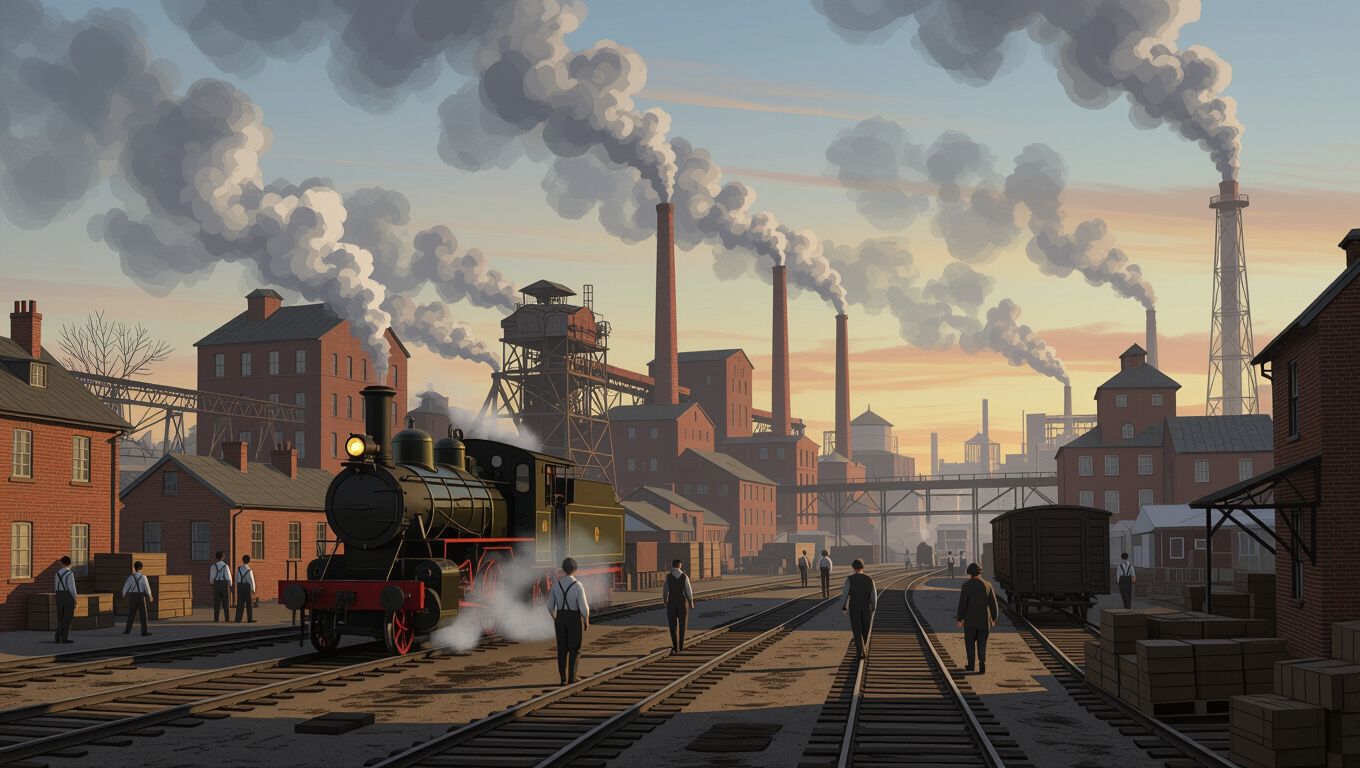
Socially, the Industrial Revolution’s applications manifested in urbanization, with Manchester’s population exploding from 10,000 to 300,000 (1770-1850), engendering public health reforms. Environmentally, coal combustion during the Industrial Revolution released 3 billion tons of CO2 by 1850, initiating anthropogenic climate influence. Gender implications saw female factory labor peak at 50% in textiles, reshaping family structures amid Industrial Revolution dynamics.
Challenges & Future
Challenges of the Industrial Revolution encompassed child labor, with 20% of factory workers under 14 enduring 16-hour shifts, prompting 1833 Factory Acts. Pollution from Industrial Revolution chimneys caused London’s “pea-souper” fogs, with mortality rates 20% higher in industrial cities. Economic volatility, including 1840s depressions, highlighted overinvestment risks inherent to the Industrial Revolution.
Looking to the future, the Industrial Revolution’s legacy informs the Second Industrial Revolution (1870-1914), integrating electricity and chemicals, and anticipates Industry 4.0 via automation. Challenges like inequality, with top 10% income share rising to 60%, prefigure modern debates on universal basic income. Sustainability futures demand decoupling growth from emissions, echoing Industrial Revolution transitions to cleaner technologies.
Comparison Table
| Aspect | First Industrial Revolution (1760-1840) | Second Industrial Revolution (1870-1914) |
|---|---|---|
| Key Technologies | Steam engine, textiles, iron | Electricity, steel, chemicals |
| Energy Source | Coal | Oil, electricity |
| Geographic Focus | Britain | Germany, USA |
| Growth Rate (Annual GDP) | 1-2% | 2-3% |
| Social Impact | Urbanization, child labor | Mass production, unions |
This table compares core facets of the Industrial Revolution’s phases, highlighting evolutionary mechanisms.
Conclusion
The Industrial Revolution irrevocably altered humanity’s trajectory, instituting sustained economic growth and technological modernity at the cost of social upheavals. Its mechanisms of innovation diffusion and market integration remain paradigmatic for analyzing contemporary transformations. Foundational concepts like mechanization underpin ongoing industrial evolutions, while implications for inequality and environment necessitate vigilant policy responses. Ultimately, the Industrial Revolution exemplifies resilience, propelling societies from subsistence to abundance.