Abstract/Executive Summary
The Industrial Revolution, commencing in the late 18th century in Britain and spreading globally, fundamentally transformed economies, societies, and technologies through mechanization, steam power, and factory systems. This article elucidates the core dynamics of the Industrial Revolution, analyzing its foundational concepts such as the shift from agrarian to industrial production, mechanisms including innovation in textile machinery and iron production, and implications for urbanization and labor markets. Key challenges like environmental degradation and social inequities are examined, alongside comparative analyses revealing disparities between pre- and post-Industrial Revolution eras. Projections into future industrial evolutions underscore the enduring legacy of the Industrial Revolution in shaping modern technological paradigms.
Introduction
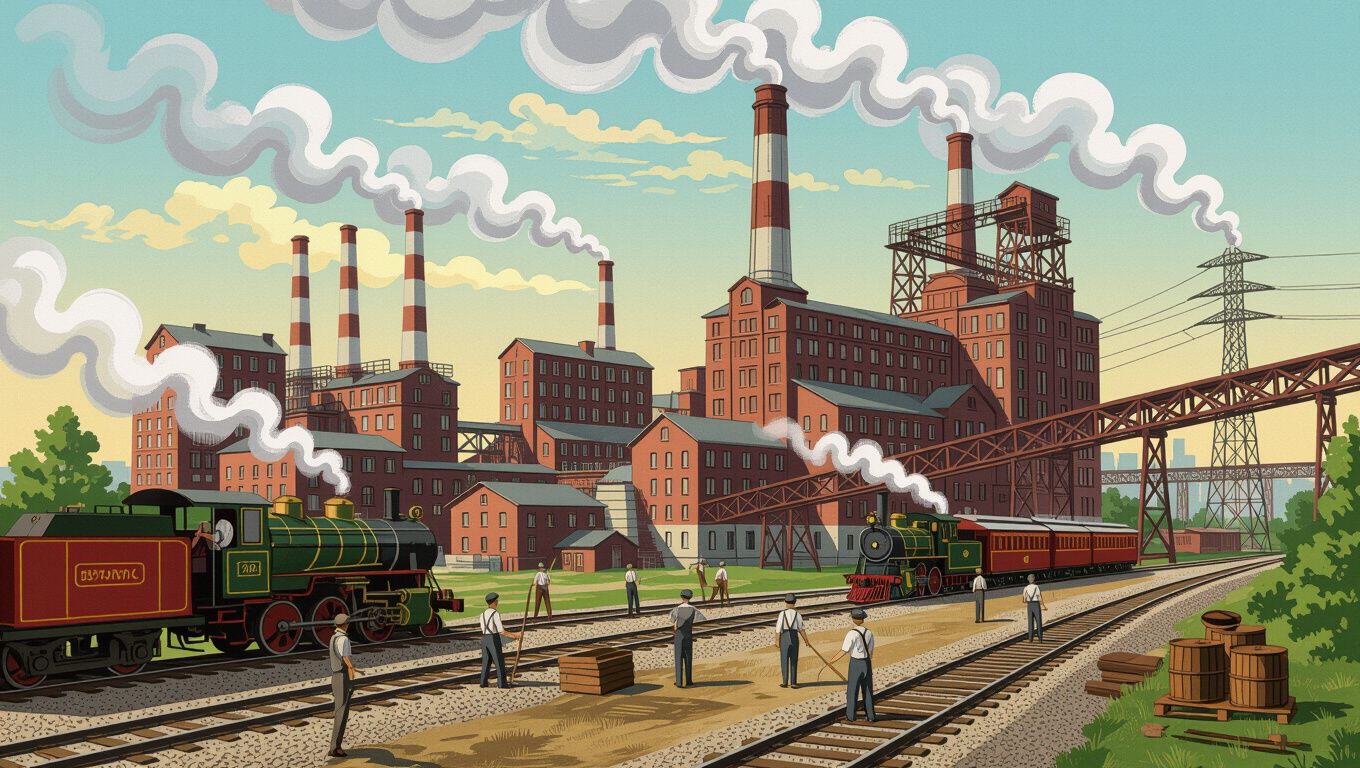
The Industrial Revolution marked a pivotal epoch in human history, originating in Britain around 1760 and extending through the 19th century, characterized by unprecedented advancements in manufacturing and energy utilization. This period transitioned societies from manual labor and domestic production to machine-based industrial processes, propelled by inventions like James Watt’s steam engine. The Industrial Revolution’s inception was fueled by abundant coal resources, colonial trade networks, and capital accumulation, setting the stage for exponential economic growth. Historians delineate it into phases, with the First Industrial Revolution focusing on textiles, iron, and steam, fundamentally altering global productivity and laying groundwork for subsequent technological revolutions.
Foundational Concepts
Central to the Industrial Revolution were concepts of mechanization and division of labor, epitomized by the water frame and spinning jenny in textile production, which amplified output exponentially. The factory system emerged as a cornerstone, concentrating workers in centralized locations powered by water and later steam, diverging from the cottage industry model. Energy transitions formed another pillar, with coal-fired steam engines replacing human and animal power, enabling scalable operations. Economic theories, such as Adam Smith’s principles of specialization, underpinned these shifts, while enclosures in Britain facilitated labor mobilization toward urban factories, encapsulating the Industrial Revolution’s transformative essence.
Mechanisms & Analysis
The mechanisms of the Industrial Revolution operated through technological synergies and market dynamics. Innovations like Henry Cort’s puddling process revolutionized iron production, supplying materials for machinery and infrastructure. Steam power’s analytical efficiency, quantified by Watt’s separate condenser increasing thermal efficiency by 75%, drove railway and maritime expansions. Economically, the Industrial Revolution fostered capital investment cycles, with profit reinvestments accelerating innovation; analyses reveal GDP growth rates in Britain surging from 0.5% to over 2% annually. Social mechanisms included proletarianization, where rural migrants formed an industrial workforce, analyzed through Marxian lenses as class formation amid exploitation, yet yielding productivity gains that defined the era.
Applications & Implications
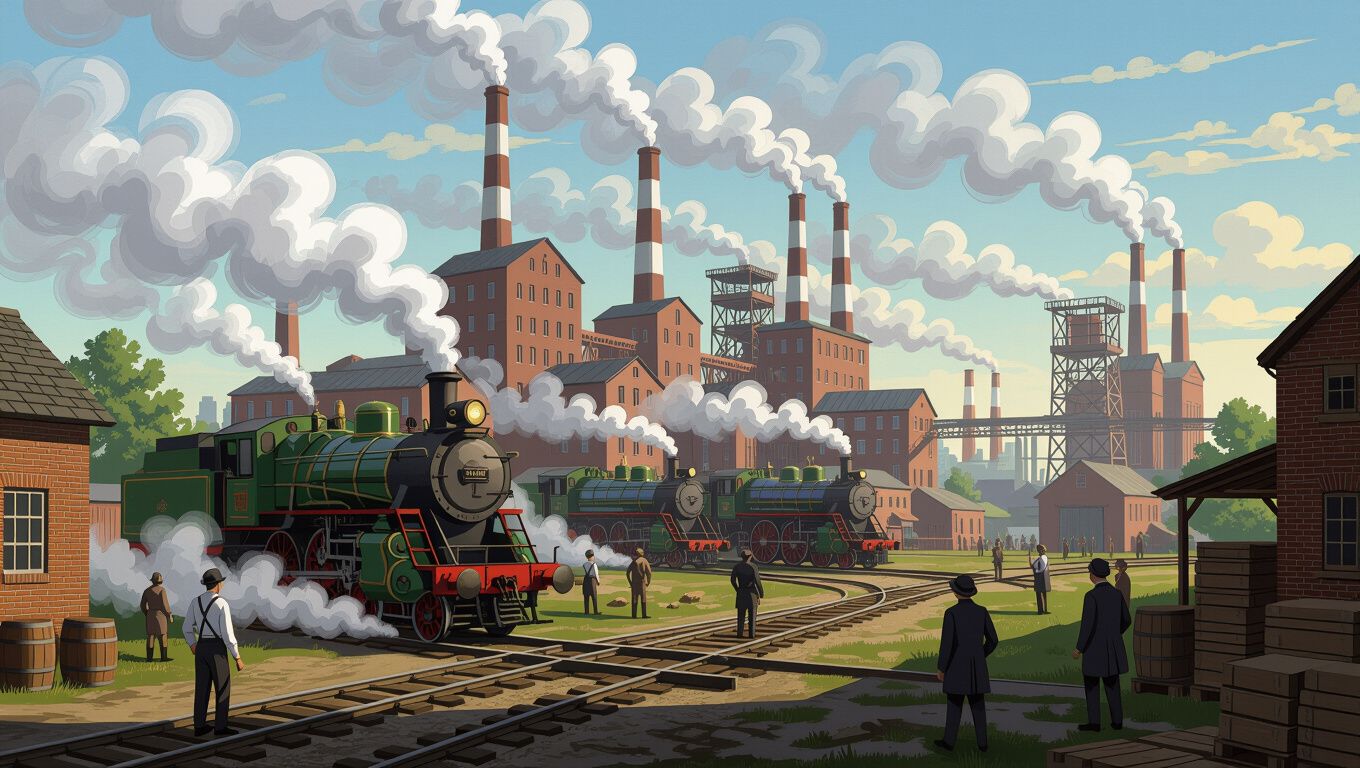
Applications of the Industrial Revolution spanned textiles, where power looms displaced handlooms, boosting cotton exports; metallurgy, enabling Bessemer steel for railways; and transportation, with Stephenson’s Rocket locomotive shrinking distances. Implications reverberated socially, spurring urbanization—Manchester’s population quadrupled by 1850—and demographically, via falling mortality from improved nutrition despite harsh conditions. Economically, it birthed modern capitalism, with stock markets and joint-stock companies proliferating. Globally, the Industrial Revolution’s diffusion to Europe and America amplified imperial expansions, intertwining technological dominance with colonial resource extraction, profoundly reshaping geopolitical landscapes.
Challenges & Future
The Industrial Revolution confronted challenges including child labor exploitation, with 19th-century reports documenting 12-hour shifts for minors, and urban squalor fostering diseases like cholera. Environmental ramifications, such as London’s smog from coal combustion, highlighted pollution externalities. Labor unrest culminated in Luddite rebellions against mechanization. Looking forward, the Industrial Revolution’s legacy informs the Fourth Industrial Revolution, integrating AI and automation; challenges like inequality persist, necessitating sustainable models. Future trajectories project bio-industrial fusions, mitigating past ecological oversights while harnessing mechanized efficiencies refined since the 18th century.
Comparison Table
| Aspect | Pre-Industrial Revolution | During/Post-Industrial Revolution |
|---|---|---|
| Production Method | Manual, agrarian, cottage-based | Mechanized, factory-based, steam-powered |
| Energy Source | Human/animal muscle, water wheels | Coal/steam engines, later electricity |
| Economic Growth | Slow, ~0.5% annual GDP | Rapid, 2-3% annual GDP surges |
| Labor Structure | Dispersed, skilled artisans | Concentrated, unskilled wage labor |
| Urbanization Rate | Low, rural dominance | High, megacities emerge |
Conclusion
The Industrial Revolution irrevocably redefined human progress, catalyzing technological, economic, and social metamorphoses that persist today. From foundational mechanization to expansive applications, its mechanisms propelled humanity into modernity, notwithstanding profound challenges. Comparative insights affirm its disruptive potency, while future-oriented analyses signal continuations in digital-industrial paradigms. Ultimately, the Industrial Revolution stands as the archetype of transformative innovation, demanding balanced reflections on its triumphs and tribulations.