
Washington, D.C. — January 6, 2026
Category: News
Trump Imposes 60% Tariffs on All Chinese Imports, Escalating Trade War Amid South China Sea Tensions
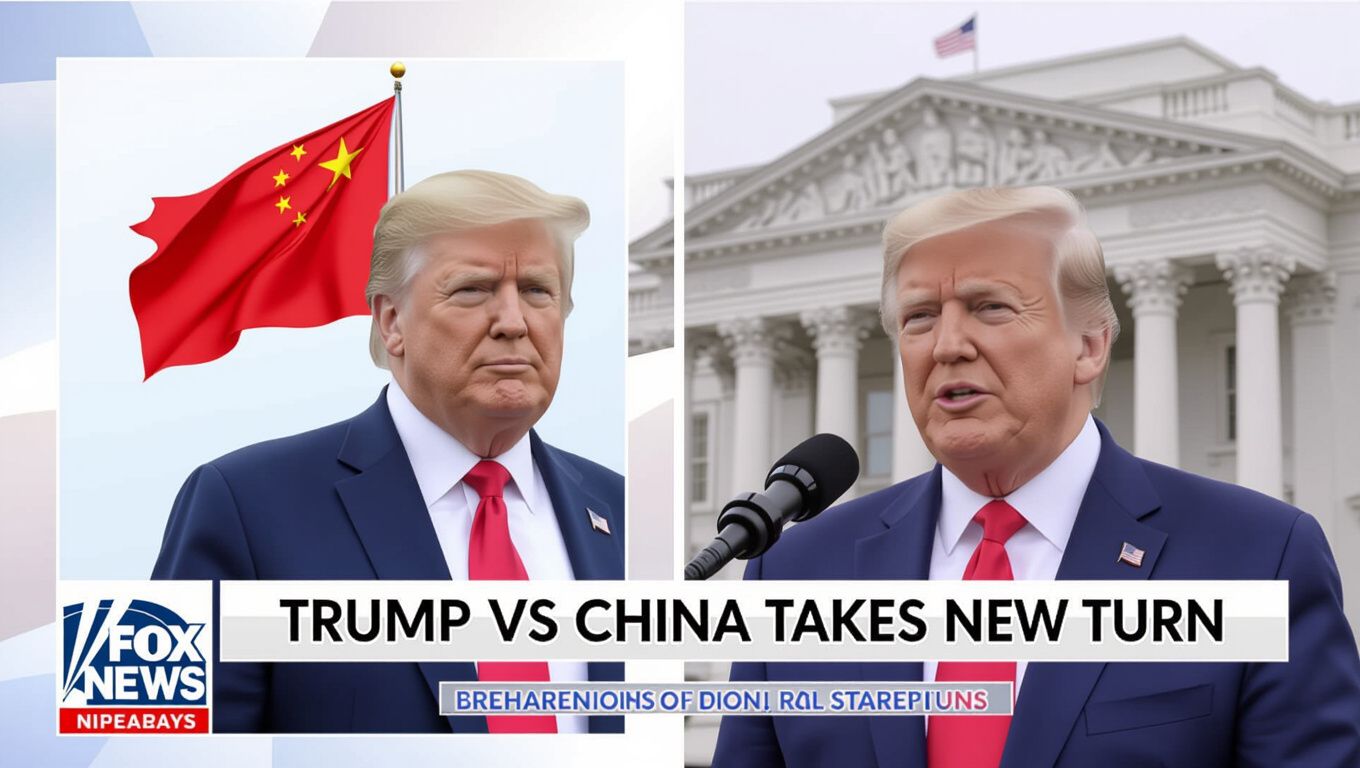
President Donald Trump announced sweeping 60% tariffs on all Chinese imports worth over $500 billion annually on January 6, 2026, from the White House Rose Garden in Washington, D.C. The move targets Beijing’s alleged unfair trade practices, intellectual property theft, and aggressive military posturing in the South China Sea. Trump stated the tariffs aim to protect American workers, bolster national security, and force China to the negotiating table on fair trade terms.
The executive order, signed during a press conference attended by top administration officials including Commerce Secretary Robert Lighthizer and National Security Advisor Michael Waltz, takes effect immediately on key sectors like semiconductors, electric vehicles, and consumer electronics. This escalation follows China’s recent devaluation of the yuan by 7% last month and its increased naval patrols near Taiwan and the Philippines. U.S. officials claim the tariffs will generate $300 billion in annual revenue while pressuring China to curb subsidies to state-owned enterprises.
The announcement sent shockwaves through global markets, with the Dow Jones Industrial Average dropping 1,200 points in afternoon trading and Asian indices tumbling overnight. Economists warn of potential inflation spikes in the U.S. and supply chain disruptions worldwide, as China supplies 20% of U.S. imports. Beijing has vowed retaliation, signaling a new chapter in the U.S.-China rivalry that dominated Trump’s first term.
Immediate impacts include halted shipments at major U.S. ports like Los Angeles and Long Beach, where Chinese goods constitute 40% of volume. Trump administration data projects 2 million American manufacturing jobs could be created over five years, offsetting short-term price hikes estimated at 5-7% on affected goods. Critics, including some Republican senators, argue the policy risks alienating allies and fueling global recession fears.
Context & Background
The U.S.-China trade relationship has been fraught since Trump’s first presidency in 2017, when initial tariffs on $34 billion in Chinese goods sparked a tit-for-tat escalation. By 2019, tariffs covered $360 billion in bilateral trade, leading to a Phase One deal in January 2020 that saw China commit to $200 billion in U.S. purchases, though it fell short by 40% according to Peterson Institute for International Economics analysis.
During the Biden administration from 2021 to 2025, some Trump-era tariffs remained, but new restrictions focused on technology exports amid Huawei bans and chip curbs. Trump’s 2024 reelection campaign promised even tougher measures, citing China’s dominance in critical minerals and its $367 billion trade surplus with the U.S. in 2025, per U.S. Census Bureau figures.
Geopolitical tensions amplified economic friction, with China’s 2025 military drills around Taiwan and construction of artificial islands in the Spratly chain prompting U.S. freedom-of-navigation operations. Reports from the U.S. Trade Representative highlighted $50 billion in annual IP theft losses attributable to Chinese firms. This backdrop set the stage for Trump’s aggressive return to protectionism upon his January 20, 2025, inauguration.
Previous attempts at diplomacy, including virtual summits in 2023 and 2024, yielded little progress on subsidies or market access. The 2025 yuan devaluation, seen by Washington as currency manipulation, directly preceded today’s announcement, echoing 2019 disputes that led to China’s U.S. “manipulator” label.
Key Developments
The tariffs apply universally to Chinese-origin goods, exempting only certain medical supplies and rare earths under national security waivers. Affected categories include $150 billion in electronics, $100 billion in machinery, and $80 billion in apparel and toys, according to U.S. Customs and Border Protection preliminary assessments. Implementation involves enhanced screenings at 15 major ports, with digital declarations required 72 hours prior to arrival.
Trump detailed a “reciprocal trade enforcement” mechanism, allowing tariff adjustments based on China’s responses. The White House fact sheet projects $120 billion redirected to U.S. infrastructure via a new “America First Fund.” Early data shows 500,000 containers rerouted from China to Vietnam and Mexico since November 2025 preemptive shifts.
Sector-specific impacts loom large: Semiconductor tariffs target firms like SMIC, amid U.S. CHIPS Act investments totaling $52 billion. Electric vehicle duties hit BYD and CATL batteries, protecting Tesla and GM. Consumer prices for iPhones and apparel could rise 15-20%, per National Retail Federation estimates released hours after the announcement.
China’s immediate countermeasures include a 50% tariff on U.S. soybeans and Boeing aircraft, announced by the Ministry of Commerce at 10 p.m. ET. Global shipping rates surged 30% on the Baltic Dry Index. U.S. allies like Japan and the EU expressed concerns over collateral damage to WTO frameworks.
Behind-the-scenes negotiations collapsed last week in Geneva, where U.S. demands for zero subsidies were rejected. Trump’s order invokes Section 301 of the Trade Act of 1974, previously used for $250 billion in tariffs. Legal challenges from U.S. importers are expected in federal courts by week’s end.
Market reactions intensified: Apple shares fell 8%, while U.S. steelmakers like Nucor rose 12%. Cryptocurrency markets, seen as tariff hedges, saw Bitcoin climb 5%. Federal Reserve officials signaled readiness to counter inflation pressures from the policy.
Reactions & Quotes
President Trump defended the tariffs vigorously during his Rose Garden remarks.
“China has been ripping us off for decades—stealing our jobs, our technology, and now threatening our allies. These tariffs will bring back millions of jobs and make America strong again,” — President Donald Trump, White House Rose Garden, January 6, 2026.
Commerce Secretary Robert Lighthizer echoed the sentiment, emphasizing enforcement.
“This is about fairness. China must end its predatory practices or face sustained consequences,” — Robert Lighthizer, U.S. Commerce Secretary.
China’s Foreign Ministry issued a sharp rebuke from Beijing.
“The U.S. actions are hegemonic bullying that violate WTO rules and harm global stability. China will take all necessary measures to defend its interests,” — Spokesperson Lin Jian, Chinese Foreign Ministry, January 6, 2026.
Economists and business leaders offered mixed views. Brad Setser of the Council on Foreign Relations warned of risks.
“While targeted tariffs can work, a blanket 60% rate risks 2-3% U.S. GDP contraction and global supply shocks,” — Brad Setser, Council on Foreign Relations.
U.S. Chamber of Commerce President Suzanne Clark urged caution.
“Higher costs will hit American families hardest— we need negotiation, not escalation,” — Suzanne Clark, U.S. Chamber of Commerce.
Taiwan’s President Lai Ching-te welcomed U.S. resolve on security fronts.
“We stand with partners committed to a free and open Indo-Pacific,” — Lai Ching-te, President of Taiwan.
Implications & Analysis
For U.S. consumers, the tariffs could add $2,600 annually to household expenses, according to Moody’s Analytics models factoring pass-through rates of 80%. Manufacturers reliant on Chinese components, such as automakers and tech firms, face margin squeezes unless reshoring accelerates, a process estimated at 5-10 years by McKinsey Global Institute.
China’s economy, already slowing to 4.5% growth in 2025 per IMF data, may see exports to the U.S. drop 30%, prompting stimulus measures like increased domestic consumption drives. Beijing could accelerate “dual circulation” strategies, reducing U.S. reliance while deepening ties with BRICS nations.
Globally, supply chains face reconfiguration: Vietnam’s exports to the U.S. surged 25% in 2025, but capacity limits loom. The EU, with its own China EV tariffs at 45%, may align partially but fears spillover inflation amid 2.1% eurozone growth forecasts.
National security ramifications extend to alliances: AUKUS and Quad partnerships could strengthen with U.S. pressure on China, yet risk escalation in the Taiwan Strait where 70% of global semiconductors are produced nearby. Long-term, de-globalization trends may boost U.S. innovation but at the cost of efficiency losses estimated at 1% of world GDP by World Bank projections.
Political fallout in Washington includes midterm pressures for Trump’s Republicans, with farm states vulnerable to retaliation. Success hinges on WTO challenges and bilateral talks; historical precedents suggest phased reductions post-concessions, as in 2020.
Broader geopolitical shifts favor U.S. decoupling in critical tech, with export controls curbing China’s AI and quantum advances. However, mutual dependencies in pharmaceuticals—China supplies 80% of U.S. antibiotics—underscore vulnerabilities requiring diversified sourcing.
Timeline
- March 2018: Trump imposes first tariffs on $34 billion Chinese steel and aluminum, citing national security.
- January 2020: Phase One trade deal signed; China agrees to $200 billion U.S. purchases.
- 2021-2024: Biden maintains tariffs, adds tech export bans on Huawei and SMIC.
- November 2024: Trump wins reelection on “America First” platform promising China crackdown.
- December 2025: China devalues yuan by 7%; U.S. labels it manipulator.
- January 6, 2026: Trump signs 60% tariffs on all Chinese imports.
As the dust settles on Trump’s bold tariff gambit, the world watches for signs of de-escalation or deeper entrenchment in U.S.-China rivalry. With markets volatile and stakeholders recalibrating, future negotiations may yet avert a full decoupling, preserving economic interdependence amid shared global challenges like climate change and pandemics. The policy’s legacy will depend on its ability to deliver promised jobs without igniting broader conflict.